***Some publications transcribed in this
section may be deemed offensive by today's standards.***
READER DISCRETION IS
ADVISED!
DO NOT email me with complaints, if
you find something offensive, DON'T READ IT!
Nothing has been transcribe with the intention of upsetting or harming anyone's
beliefs, ideas, or ethnicity.
These are transcriptions of actual books
and documents, to edit them would change their historical significance.
By putting these documents online, I am in no way suggesting that the
ideas expressed in these publications by the original authors
are beliefs or ideas that I have or maintain.
|
BRUNSWICK
To the Exporter,
Importer, Investor, To the Fruit and
Truck Grower, To the Health and
Pleasure Seeker. Written by…WM. S. IRVINE
ISSUED BY Pg. 3 Location. Brunswick is situated about half-way between Savannah and Jacksonville, on the Georgia coast of the Atlantic Ocean, and within a few miles of the Florida line. It is built upon a peninsula—which is almost entirely surrounded by deep salt water streams—making the location unusually healthy, and at the same time offering shipping and commercial advantages that are unsurpassed. Population and Growth. The growth of population from 2,891 in 1880 to 9,081 in 1900 (according to government census reports) reveals an increase that has advanced Brunswick to the seventh city in size in the State of Georgia. It is now the second largest city in south Georgia and is a most important commercial point. The population has increased 25 per cent. since 1900, giving us to-day over 12,000. Commercial. Within the past decade the
port of Brunswick has made marvelous strides in the various channels
of its commercial progress and development. With but a limited
banking capital wonderful results have been accomplished.
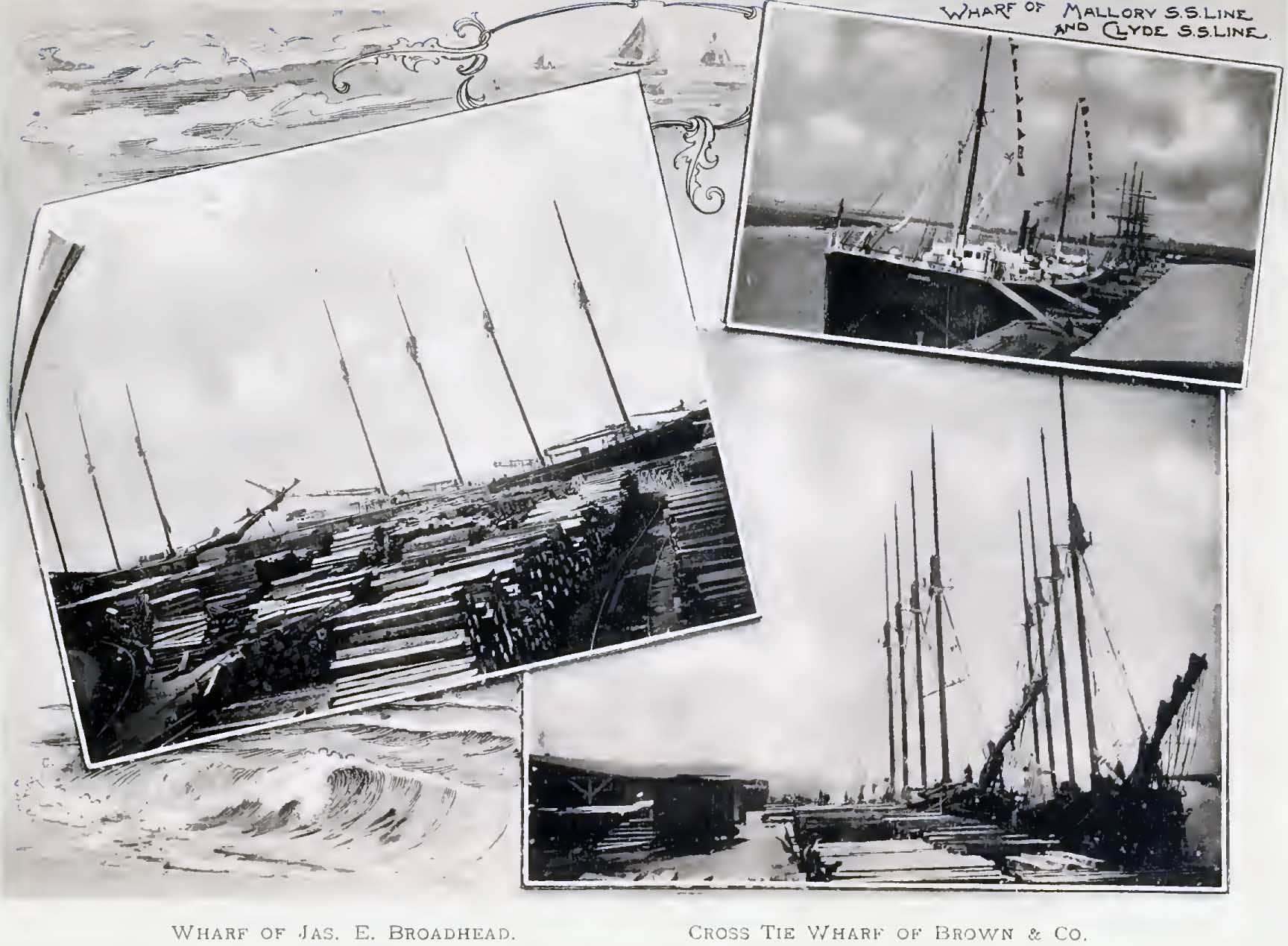
Pg. 5 In foreign shipments of all classes of products Brunswick ranks Second, having increased 200 per cent. within the past nine years. Territorial Radius. The commercial territory subjected directly to the economical trade and traffic conditions existing at the Port of Brunswick is only limited relative to the volume of tonnage that can be delivered through its matchless harbor with its thirty-eight miles of deep water ways—by its superior railway systems traversing the breadth of the United States—and by its reach of inland waterways penetrating the heart of the state. Transportation Facilities. Brunswick
has excellent transportation facilities, greatly surpassing the
majority of all the southern ports. There are two lines of
coastwise steamships, Mallory Line to New York, and the
Clyde Line to Boston, with regular weekly trips, carrying both
freight and passengers, and connecting at Brunswick with the
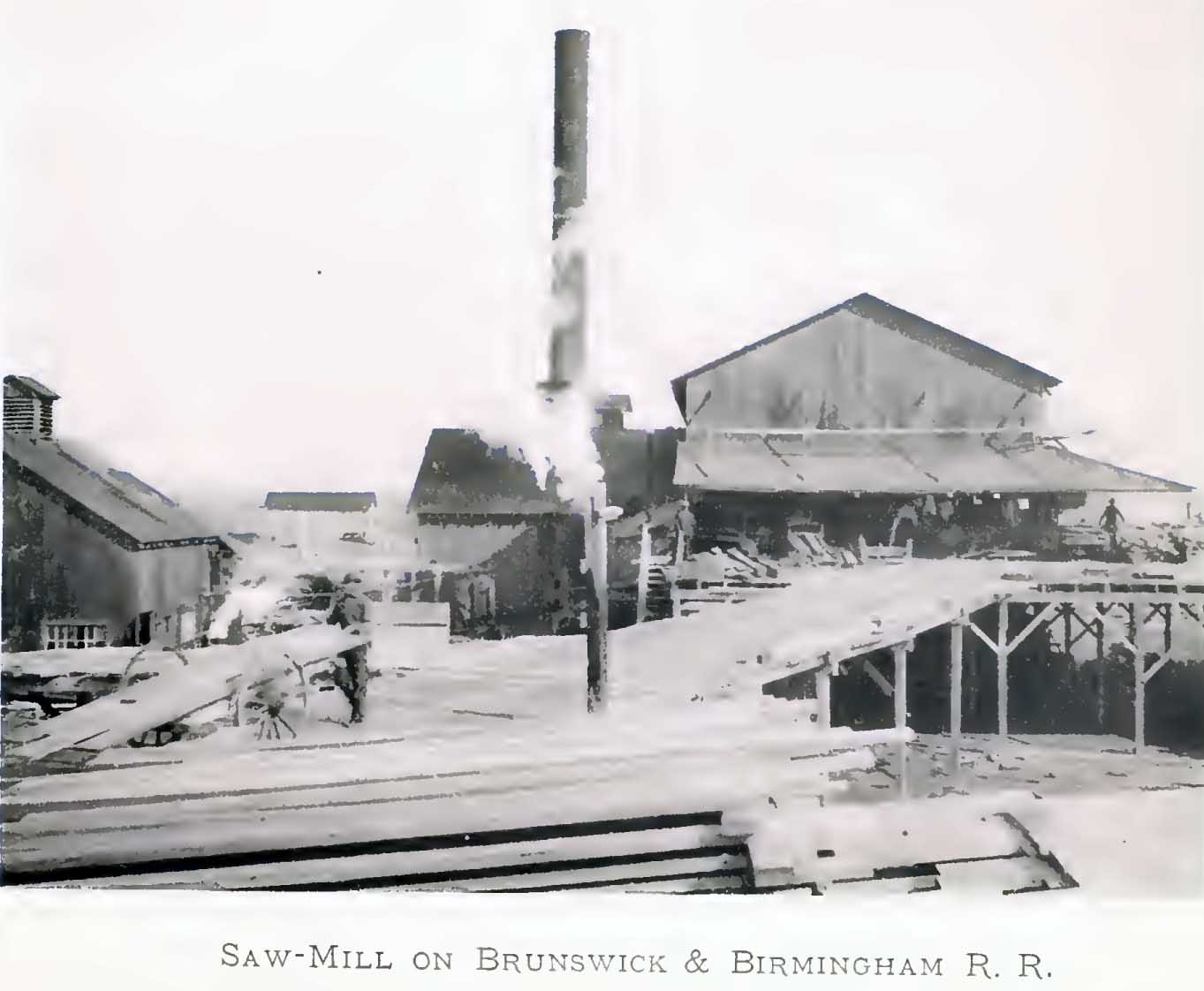
Southern Railway, the Plant System, the Brunswick and
Birmingham Railway, affording direct connection with the
Seaboard Air Line; also with the Cumberland Route of
inland steamers to Cumberland, Fernandina, and all Florida points;
with inland steamers to Jekyl Island, St. Simon Island, Darien,
Satilla River points, and Altamaha River and tributary
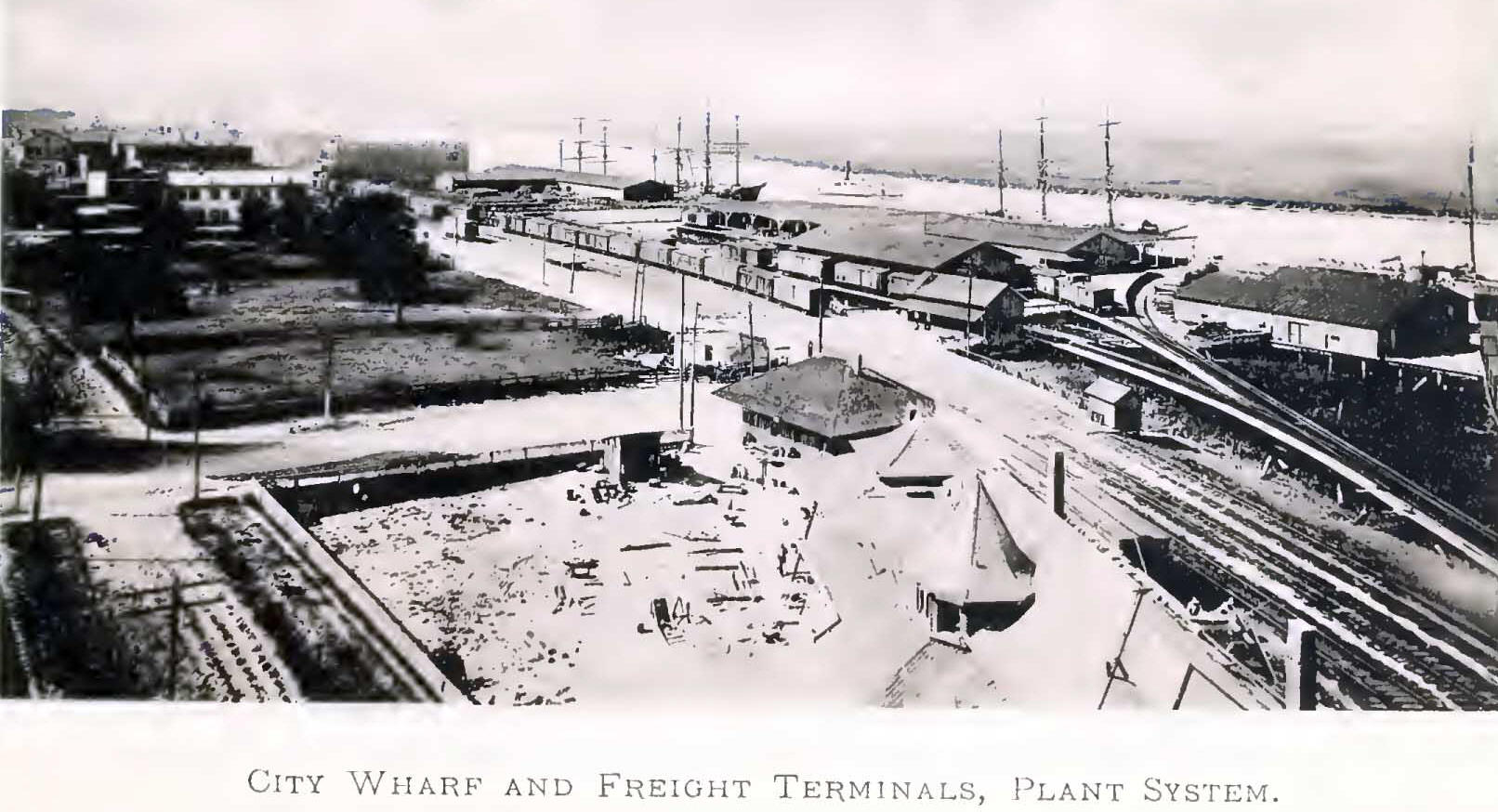
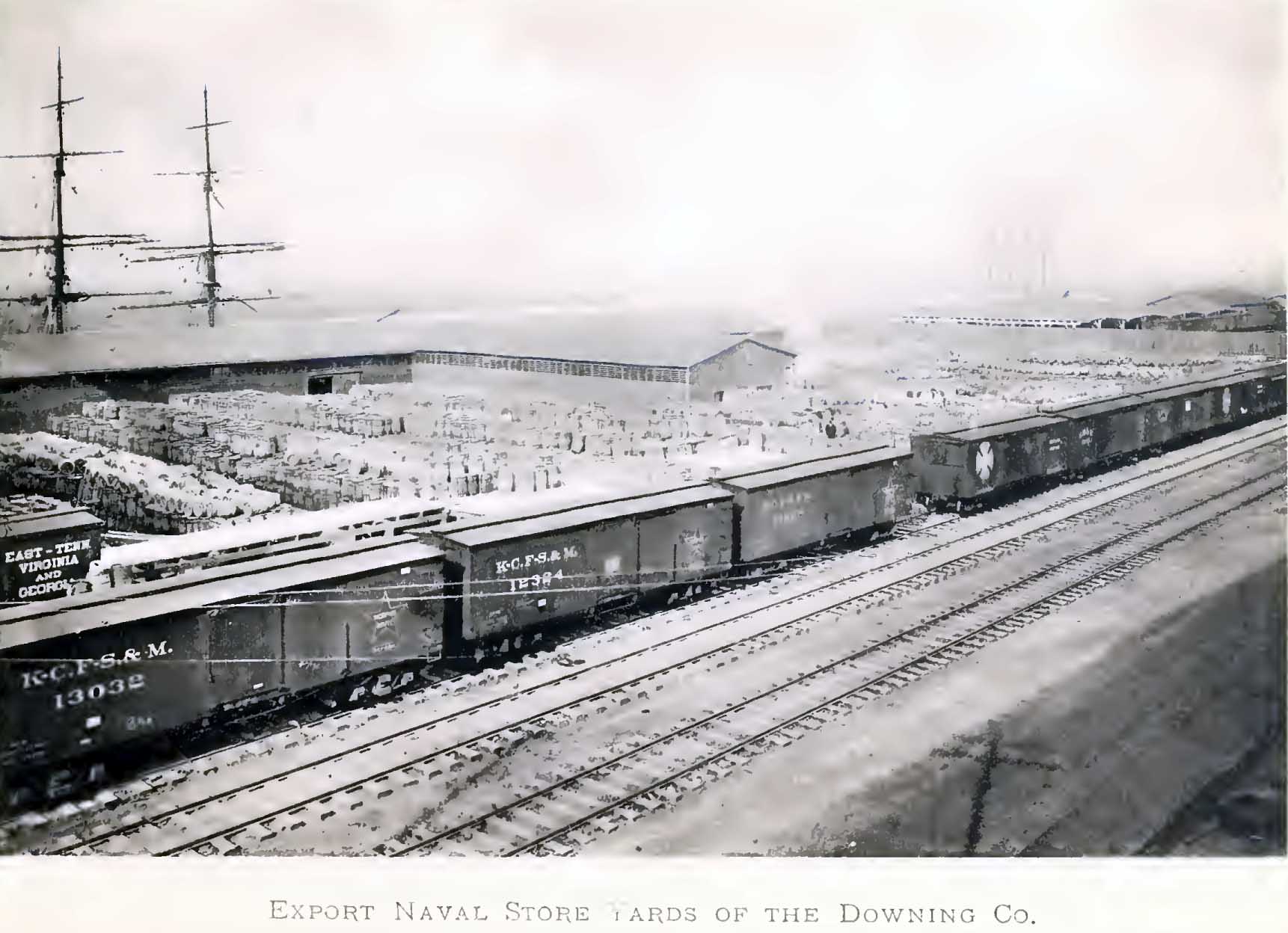
river points, etc. Railroads. The Southern Railway with its 6,433 miles of track and unequalled connections throughout the great southeast—from the Mississippi River to the Atlantic Ocean—has its deep water terminals at Brunswick, with excellent facilities for the shipment of both coastwise and foreign cargoes of coal, iron, grain, cattle, cotton, lumber, timber, naval-stores, and all kinds of manufactured products, from its vast territory, and for the import of every class of tonnage. Pg. 6 The Plant System extending
its 2,183 miles of trunk-lines from Alabama, Florida, Georgia, and
South Carolina, and connections everywhere, ahs valuable terminals
at Brunswick, now nearing completion at a cost of $1,000,000, and
adapted for the economical export of phosphate, lumber, timber,
naval-stores, cotton, fruit, garden-truck, and various articles of
manufacture, and for the import of all classes of tonnage.
Pg. 7 can be delivered by the Brunswick & Birmingham
for distribution to the great industrial centers of the west at the
lowest ocean freight charge, because of the unsurpassed deep water
facilities at Brunswick, where three immense basins, or slips are to
be constructed, each measuring 300x2500 feet to accommodate the
shipping; these slips will be equipped with every modern convenience
for loading and unloading all classes of imports and exports,
including, coal, iron, phosphate, resin, turpentine, cotton, lumber,
fruit, general merchandise, manufactured products, etc., and a
special feature will be the mechanical devices for the rapid coaling
of steamships thereby enabling them while en voyage to come in and
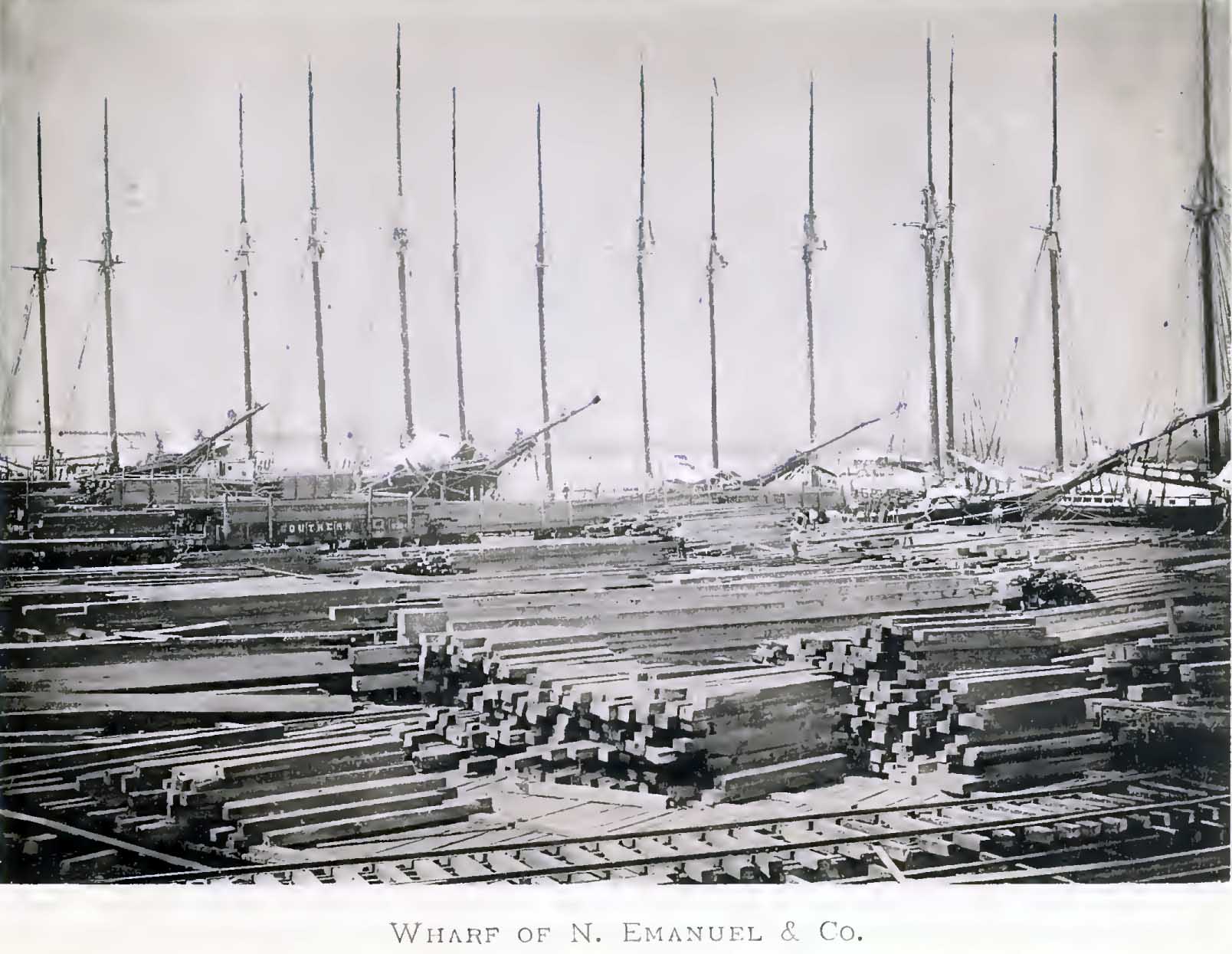
coal and then depart on the same tide. The Port, Harbor. Brunswick has the finest, largest and safest land-locked harbor on the south Atlantic and Gulf coast. The present depth of water in the ship-channel, across the ocean bar at the open sea to the docks, is 25 ½ feet at ordinary high tide; but because of the increasing number of large draft vessels entering the port much deeper water is to available in the near future. In all there are 28 miles of deep water front convenient to the railroad facilities of Brunswick. Ocean Bar. The improvement of the ocean bar is unique, as compared with all ocean bar improvements, either in this or other countries, because of the fact that while all work has been suspended since November, 1899, the channel is substantially the same as when work was discontinued—not necessitating, the expenditure of one penny for its maintenance, while other such bar channels, artificially procured, require large annual outlays to maintain them. Pg. 8 Facilities. The important point in transportation is the tonnage, and the available carriers, with their per-tonnage cost per mile. The Port of Brunswick has the available carriers in its railway lines, and to every source of tonnage supply throughout the great southeast and middle west, and by being absolutely nearer to these centers of industry has the shorter mileage, thereby reducing the tonnage cost to a minimum; as for instance, Brunswick is 500 miles nearer to Kansas City, Memphis, Nashville, than New York, and nearer to these points than any other south Atlantic port. Brunswick is also the nearest Atlantic port to the Pacific coast, being 1,200 miles closer to the Pacific than New York, affording a logical port for the shortest trans-continental route. Besides being a nearer port to all these important points Brunswick has unusual advantages in its deep-water facilities. Because of the 25 ½ feet of water in the channel over the ocean bar, and an equally as deep a harbor, large vessels of great carrying capacity can enter with, and for, cargoes of unusually heavy tonnage. Vessels of large tonnage require great depth of water, and the cost per ton per mile when transported by such vessels is less than can be given by lighter draft vessels. Add together these indisputable facts, the deep-water economy to the short railway mileage economy, and Brunswick’s logical superiority is at once recognized. So true is this that the water freight rate from the South Atlantic and Gulf to the eastern coastwise points and return is based upon the rate from Brunswick to New York; and not only is the rate made upon the basic conditions of Brunswick’s advantages, but the actual freight passing in and out via Brunswick passes at much less rate than at other South Atlantic and Gulf ports. For instance, when lumber rates are based on Brunswick to New York at $5.00 per thousand feet, from Jacksonville and Fernandina the rate would be at $5.35 and $5.50; and from Savannah and Charleston $5.25 and $5.35. Freights from New York and eastern points via Brunswick to the interior show the same difference as to the decrease in cost of transportation. In foreign shipments the same proportion of low rates is just as manifest; cotton to Liverpool, when quoted at 25 shillings, the Gulf rate would be 28 shillings and more; while “private terms” charters are invariably less than the regular rate because of the fact that shippers can get mixed cargoes here of cotton, cotton products, phosphate, iron, timber, lumber, naval-stores, etc. While the economical freight facilities, because of the present depth of the harbor and bar-channel,
have reduced the south’s cost of
transportation, it is to be seen what greater benefits will accrue
when the projected depth is obtained. Pg. 10 COMMERCIAL OPPORTUNITIES. Banking Capital. There is no point within the radius of the commercial and industrial empire designated as The Great Southeast that can as strongly and safely show such feasible possibilities and opportunities for investment in, and capitalization of, commercial enterprises, as the port and city of Brunswick. The present volume of working capital is now outgrown and is utterly inadequate to the demands of the port’s coastwise and foreign export and import commerce, necessitating the purchase of foreign exchange and bill of lading financial advances at other banking centres. A banking capital of fully $1,000,000 more is needed for the present volume of trade, not to consider the amount of working capital absolutely needed for the profitable factoring of naval-stores, lumber, cotton and rice; for manufacturing enterprises and the development of a nearby territory that is now calling for legitimate co-operation of capital. Capital is needed to develop and exploit many industrial enterprises that will pay handsome dividends. Brunswick and the immediate territory affords intrinsic opportunities that must have the leverage of capital: And Capital Located at Brunswick, thereby retaining at home the amounts paid out in interest alone to the financial centres of the East. This territory is actually suffering because of insufficient capital. Building Capital. What is true of the need of more banking capital is also as true of the need of more Building and Loan Capital. Hundreds of individual people own town lots who would build homes if they had the assistance of liberal capital. And many others would purchase land if they could see a reasonable prospect of building a home. This applies to the needs of the city; but equally as great should be populated and developed. The bulk of the wage earners are living in rented homes, and the bulk of them receive wages equal to any in the nation relative to the economical conditions existing at Brunswick. And the demand for renting houses is far in excess of the supply. This feature warrants more homes and calls for more capital.
Steamship Lines: More Needed. The
trade possibilities with the West Indian Islands opens up an
opportunity for the successful operation of a line of steamships
from Brunswick to these nearby and valuable markets. There is not
now a regular steamship service to these markets from any South
Atlantic port. Considering the already immense amount of trade
existing between them and the United States and its increasing
volume, it is to be realized that there is a rich field for a line
from Brunswick, which is the nearest South Atlantic deep water port,
and by its unexcelled railroad connections to the interior affords
advantages not to be obtained elsewhere on the entire South Atlantic
seaboard. With the rapid strides during the past ten years within
the immediate railroad territory of Brunswick there is now no
business reason why the various raw and manufactured needs of these
island markets cannot be exported through Brunswick at a great
advantage in time and profit, against the route from Baltimore and
New York, and in turn receiving from them a great percentage of the
products imported into this country—at least that portion of them
consumed in the South Atlantic and middle Western States. Pg. 12 Bonded and Storage Warehouses. In connection with the prospective inauguration of steamship lines to the West Indies and Central and South American countries, and an increasing import trade with these and other countries, the need of storage and bonded warehouses become apparent. Having these the interior importer will better realize the railroad advantages with their territories extending inward from Brunswick, and will adopt this plan of saving extra transportation and incidental expenses by holding reserve stocks at such an available point for distribution to the centres of consumption. And, also, for exporters to hold reserve stocks subject to foreign demand. The storage warehouse feature is also applicable to the coastwise traffic. Coastwise Steamship Lines to Philadelphia. The need of a line of steamships to either Baltimore or Philadelphia is one of the present and urgent demands. The volume of coastwise trade between these centres and the South has grown to such an extent that the lack of carriers to move the tonnage has been an impediment to commercial progress. With the unexcelled harbor advantages and a wide range of railway mileage, having shorter distances to the centres of the industrial, commercial, manufacturing, and agricultural sections of the South and Middle West, Brunswick offers an advantageous traffic basis of mileage, tonnage and transportation economy that stands without an equal. Electric Power and Railway. Brunswick is without electric power in the day-time; and without any street railway. The built-up section of the city extends for about 2 ½ miles by 1; then at thee limits, and within two miles beyond to the east, are two settlements and two large lumber mills, while to the west is the Southern Railway docks and a settlement—between these extreme points there is now a population of fully 15,000 people without any low priced carrier. In addition to these conditions there are beautiful places beyond the town limits suitable for amusements, parks, race tracks, ball grounds, picnic grounds, etc., several of which are in thick forests of spreading oaks, pine, palmetto, magnolia, etc., and front upon the inland water courses. That a day current of electric power is needed is a conclusion long since reached by the merchants, manufacturers, and household demands.
As an opportunity for such an investment, no place in the South offers such unusual inducements as Brunswick. Wholesale and Jobbing. In the wholesale line there are several large houses in Groceries, Grain, Hay, Meats, Liquors, Dry Goods, Drugs, etc. Mercantile Opportunities. There are A1 opportunities here for general jobbing houses because of low freights to interior points via Brunswick. Railroad facilities for handling such shipments are of the very best; see article devoted to Transportation Facilities and Territory. Among jobbing opportunities are those of drugs, hardware, woodenware, tinware, boots, shoes, dry goods, clothing and general supplies. GENERAL INFORMATION. Real Estate. Cost of lots for
building purposes depends upon the location. In the suburbs
excellent sites are available costing from $25.00 per lot and
upward; then advancing in price until the business centre is
reached, where property has a greater value.
Investments: The above facts connected with the unsupplied demand for homes demonstrates the opportunities for real estate investments in and adjacent to Brunswick. Many of the same features apply to the rural districts where land is now valued at prices running from $2.00 per acre up to $100.00, either cleared or covered with forest growth. Cost of Living. Staple
provisions of all classes are moderate, with a lesser cost in garden
truck, fish, oysters, shrimp, etc., and ordinary fresh meats. Dry
goods, clothing, and all wearing apparel, average prices. Household
supplies, such as furniture, crockery, glassware, tableware, etc.,
are to some extent less than at other places. Coal, wood, gas,
electric lights, ice and water, ordinary prices. Servant
hire—cooks, $6.00 to $15.00 per month; nurses, $5.00 to $10.00;
laundry work, $3.00 to $6.00 per month. Houses rent from $7.00 to
$45.00 per month, according to size and location of dwelling. The
market prices of dwellings already built is wonderfully low, in this
respect much less than at other points because of the low price of
lumber and material.
The Tax Question. Taxation does not cause any heavy burden in Brunswick with property owners. The tax returns of the city for the year 1901 amounted to a valuation of $5,070,879 of both personal and real estate properties, but excluding those exempt from taxation; upon this total there is a tax rate of $1.40 on the $100.00—added to this is the state and county tax rate of $1.37 ½ on the $100.00, a total of $2.77 ½ on the $100.00. Under present conditions, there is a prospect of even this low rate being reduced within the next two years, because of the fact that the taxable wealth of both the city and county is steadily increasing, and the operating expenses are not. Or if contemplated improvements in the city and county, which are being agitated, such as paved streets, park extensions, purchase of water and light system, improved county roads, new court house, and others, are put into effect, there will not be any increase in the present rate because the annual increases in valuations will afford ample revenues. The financial condition of both the city and county is excellent. The city’s bonded debt is $262,000, and the county $61,000. Under present conditions the indebtedness of both city and county is being steadily reduced.
Educational. Brunswick and Glynn
county have a thorough system of graded, public schools, from the
primary department through the grammar grades and a finishing course
in the high school. The corps of teachers are carefully selected.
The average attendance of pupils last season was 92 per cent., which
was the highest in the entire state. Constant attention is given to
advancing the methods, books, and the general welfare of the system
all during the terms, which has had a marked effect in improving the
general interest of education. Graduates from the high school may
go direct to many of the colleges and universities without further
preparation. Churches. Both the city and the
county are supplied with churches of the leading religeous faiths,
as (white) Episcopal, Presbyterian, Methodist, Baptist, Catholic,
Second Advent and Jewish; (colored) Methodist, Baptist, Episcopal.
Many of the edifices compare favorably with those of larger cities. Library. There is a well-appointed Public Library. Also excellent libraries in the public and private schools.
CLIMATE. Climate. There is no location in America which has a more equable and pleasant summer temperature than Brunswick. The mean temperature upon an average for past five years during the six months, April to October, is 77 degrees. The highest average of any month is in August. The direct breezes from the ocean, six miles distant, brings into the streets the freshness of the sea, making unbearable heat an impossibility. There is no more delightful winter climate in the world, not even the famous resorts of France, Italy and other Mediterranean points. The average mean temperature from October to April is 50 degrees; the lowest average being in January. It is healthful and pleasant the year round. The preponderance of days in the year being clear. Health Record. With a perfect
system of sanitary sewerage and drainage, pure artesian water,
salubrious and delightful climate. Longevity outbalances its death
rate. The average for past five years is, white 9 to 1,000.
Colored 11 to 1,000. Sewerage and Sanitation. Brunswick
is supplied with the finest sewerage system to be found in any
American city. This system was finished in 1894, under the personal
direction of the late Col. Geo. F. Waring, the eminent
sanitary engineer. This magnificent system has been adopted by the
U.S. Marine Hospital as a model system; the government will
construct a similar system at Havana, Cuba. The city and
surrounding country have also been supplied with a thorough system
of surface drainage. Pg. 17 location being upon salt water streams (fresh water being 12 miles distant), the highest sanitary precautions of man are present to insure immunity. Water Supply. Nature has provided, and the genius of man brought to light a wonderful yield of pure artesian water, from depth readily accessible. These artesian wells are bored to a depth of from 400 to 600 feet and yield an unfailing supply. The analysis of these wells disclose the medicinal value of the water as well as their purity for all domestic and manufacturing purposes. Here is one of them: Carbonate of
Soda………..….8.083 These wells form the source of supply for the water work system. Miscellaneous. The city has a
well equipped paid fire department.
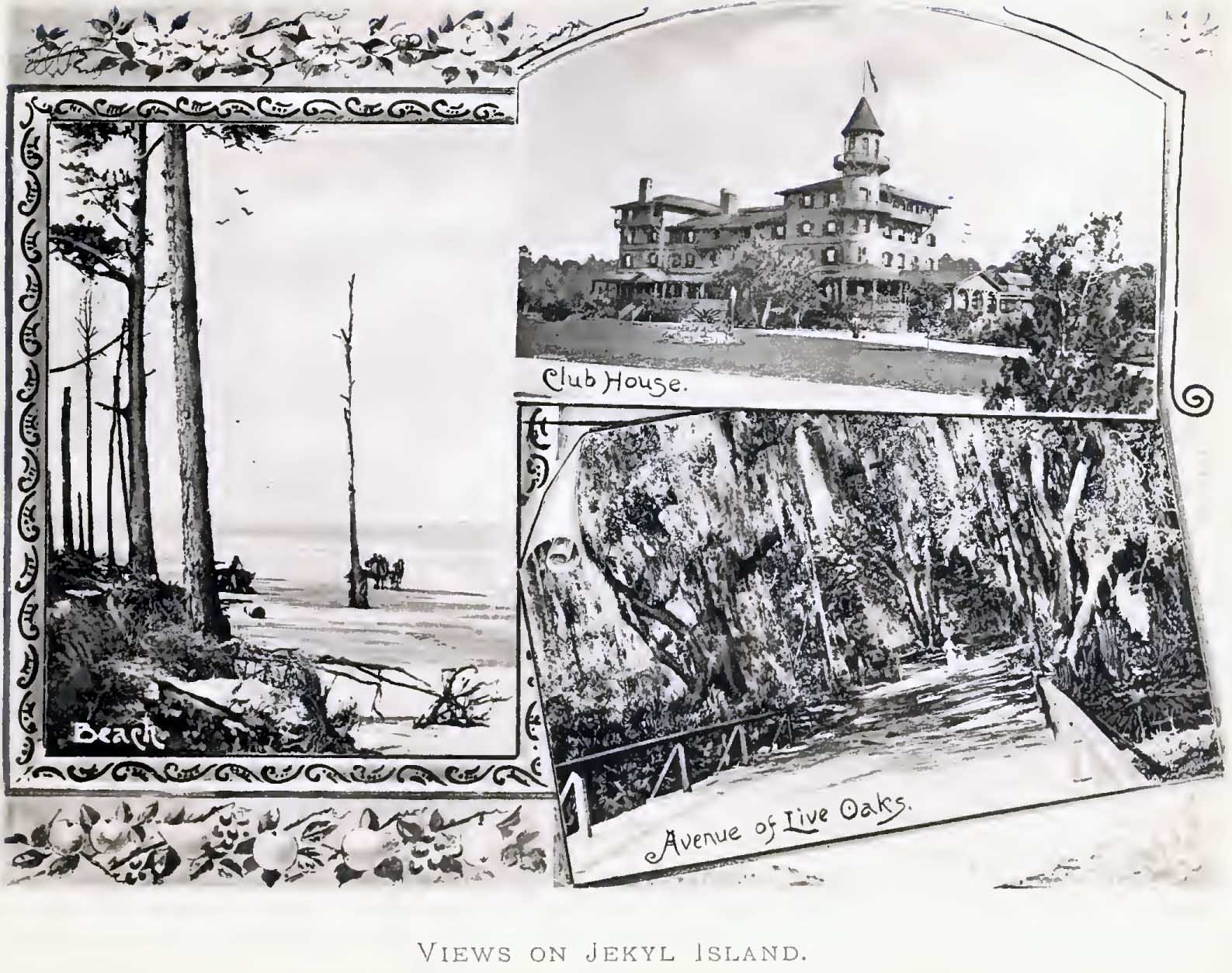
WINTER AND SUMMER RESORTS. Jekyl Island. In sight of the busy wharves of Brunswick, and but a few miles distant, is Jekyl Island—historic in the annals of Georgia’s early settlement, and now the winter home and resort of the Jekyl Island Club—an exclusive social organization of the greatest American financiers, the membership embracing the wealthiest aggregation in the world. This club owns the entire island, and besides making it the most unique game preserve in America, having stocked it with game of wing and foot from the forests and fields of two hemispheres, have also erected magnificent buildings for their homes. To such an extent have these and other improvements, as landscape gardening, shelled roads, and boat landings, been added to the grandeur of the natural beauty of its forests, streams, and countour, that now it is styled “The Riviera of America.” Reaching out eastward with its stretch of magnificent beach, into the Atlantic ocean where the sea green waters mingle with those of the balmy-blue gulf stream; then spreading northward to the sound, where in the near distance St. Simon Island faces also to the sea; then sweeping southward, where a few miles away lies Cumberland Island—the winter home of the Carnegie’s; then westward to the “Marshes of Glynn,” across which is seen the shipping in Brunswick’s harbor. Historic in the early days as the one-time residence of General Oglethorpe; famed in the reign of the West Indian pirates as the treasure island of Black Beard and Red Rover and other of this ilk; the rendezvous of cut-throats, plunders, and scene of Indian massacres in the dying days of the eighteenth, and natal days of the nineteenth centuries; the trysting place of British pillagers and freebooters in the war of 1812; notorious in the days of the ‘40s as the place where the last slave ship, the “Wanderer,” touched America shores with its marketable human freight; and now in the later years world-known because of its rich gentlemen’s club. Books could be written of its beautiful evergreen and semi-tropical trees of oak, pine, palmetto, magnolia, bay, laurel, cedar, with their intricate draperies of Spanish moss, climbing vines of rose, bamboo, gypaea, creepea, jassamine, etc.; of the endless varieties of ferns and shrubbery; of myrtle-bordered walks; and miles of shelled driveways through vistas of semi-tropical flora. Among the handsome homes of the members are the Italian villa of Edwin Gould; the French Pg. 19 chateau of the Maurice family; the
cottages of Gordon McKay, Frederic Baker, N.K.
Fairbank, William Struthers, Joseph Pulitzer,
H.K. Porter; beautiful apartment house “San Souci,” owned by
J. Pierpont Morgan, Wm. Rockfeller and Cornelius Bliss,
and the “Imperial” owned by Samuel Spencer and others. Among
the club members are the following world known men: St. Simon Island. At the same distance that Jekyl is from Brunswick is the summer resort island of St. Simon. More historic than Jekyl, and not exclusive to a limited number of people, it is the glory and joy of thousands of inhabitants from the interior of the southern and middle western states, who flock to its surf and invigorating climate in the summer months, from May to October. St. Simon Island has been called the “Cradle of American Liberty.” Here Oglethorpe, the founder of Georgia, in 1736 planted a colony and built a fort, which he named Frederica. He found the soil and climate adapted to oranges, olives and other semi-tropical fruit; oil was made from lives; silk culture was successful; and other similar enterprises encouraged. But the frontier trouble with the Spanish at that time interfered with the fulfillment of his plans, and the island became the field of war instead of peaceful pursuits. A decisive encounter between the two forces at Bloody
Marsh, July 4th, 1740, virtually
stopped the hostilities, but the early return of Oglethorpe
to England ended the bright prospects. But during his days it
blossomed as a rose, and outrivaled Savannah in importance. Here
the two Wesleys came and labored in 1736—John at
preaching, and Charles at Oglethorpe’s side, as his
secretary. Frederica to-day boasts the ruins of the old fort on the
river side, and the barracks further in, both built substantially of
adobe (oyster shells and sand) and English brick; father on, the low
ridge of an earthen rampart still bears witness of a fortified town
of considerable size. Beyond is a scattering pile of debris,
marking the site of Oglethorpe’s house. In an adjoining
thicket dismantled vaults tell that the grim destroyer passed among
them. Still farther on, surrounded by patriarch oaks, hoary with
grey Spanish moss, stands a venerable tree, more kingly than all,
which is pointed out as the oak beneath whose expanding branches, in
the dim light of the forest there gathered both the red men and his
pale-faced exterminator to listen to the words of the Great Spirit
as spoken by John Wesley. Ever inward and outward through
the groves, myrtle walks, and on the beach, Charles Wesley
walked, meditated and composed the first hymns and songs of his
immortal verse. Pg. 21 The Hotel Oglethorpe. This magnificent hostelry was built a few years ago at a cost of $185,000, and has just been remodeled at an additional expense, greatly improving its facilities for the entertainment of the thousands of visitors and strangers coming into Brunswick. It has accommodations for 300 guests, serves an elaborate bill of fare, is well managed, and open all the year. This structure is built of brick with stone trimmings, and has large and ample piazzas. It affords beautiful views overlooking the harbor with its shipping, and the city with its tree-lined streets. INDUSTRIAL BRUNSWICK. Manufacturing Enterprises. The various manufacturing enterprises in Brunswick are to a great extent only infant industries. Although in comparison with the whole state Brunswick makes an excellent showing. The government census of 1900 enumerates 73 establishments in the city limits, capitalized at $423,826, employing 550 wage earners, using $551,817 of raw material, and producing $1,171,378 of finished product. In the list of urban manufactures Brunswick ranks 8th in the State, only proceded by cities of greater population and wealth. Just outside of the city, but within the county, there are 11 more manufacturing establishments with a capital of $253,733, employing 344 wage earners, with a production amounting to $506,647; making in all a grand total of 84 establishments, having a capital of $677,559, employing 894 wage earners, and producing an output valued at $1,678,025. Since the census was taken several new establishment have begun operation. In addition to these industries, while well diversified, Brunswick offers unusual advantages for many others, and for some on a large and extensive scale. There are opportunities here for many enterprises necessitating but the employment of a medium amount
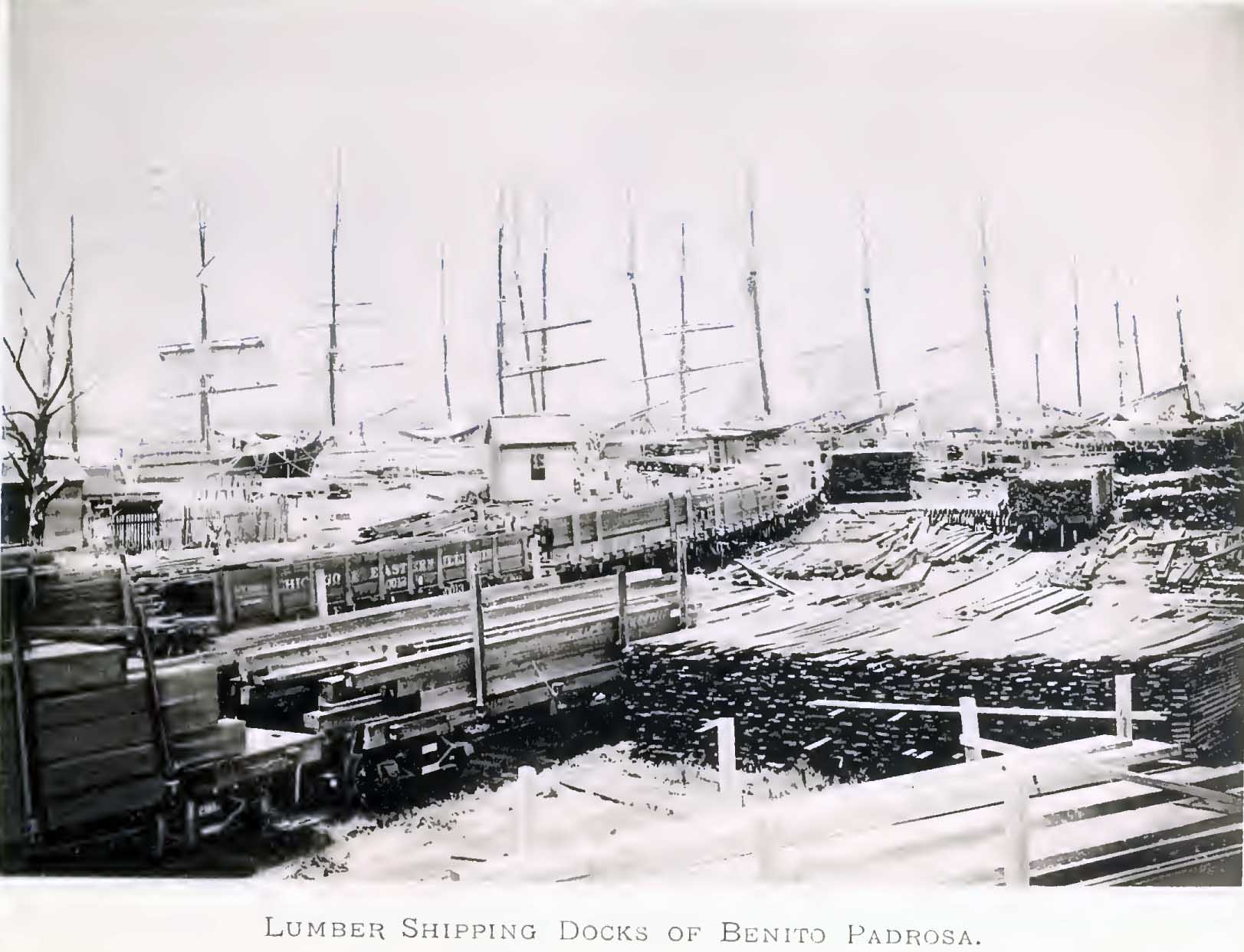
of capital; for there is a demand for the productions, and there is an extensive market, with every advantage of nature—climate, raw material, labor and freight rates. A special list is appended. Manufacturing Advantages. Brunswick is the great concentration point for the raw material which exists in the forests, mines and fields of the southeastern portion of the United States. The three main trunk lines of railway, and their feeders, of that section, penetrating every source of supply, finds the shortest route to the Atlantic sea-board, with the lowest possible tonnage rates, at Brunswick, where, because of the deep water advantages and port facilities, the lowest ocean rates in turn delivers every class of product, whether raw or manufactured, to the markets of the world. Because of these advantages and attending opportunities, Brunswick offers to manufacturers a low rate on iron, steel, coal, coke, etc., from Alabama, East Tennessee and North Georgia; a low rate on cotton and cotton manufactures from middle Georgia and Alabama; a low rate on timber, lumber and timber products of gum, cypress, pine, oak, ash, tupelo and other woods from points within 6 miles of the city outward to the spreading forests of Georgia, Florida and Alabama. Labor Conditions. There has never been any serious labor disturbance in Brunswick. The relative cost of labor compared to other points in the south is about the same; but there is a spirit contentment among the laboring classes that assures the manufacturer a steady co-operation, which is far better and more profitable than a cheap and shiftless labor. Fully two-thirds of the male population, both white and colored, is employed in labor pursuits—on the various docks, wharves, warehouses, mills, factories and trades. Racial disorders have never disturbed the industrial, commercial, social or religious progress of the people. Perhaps at no place in the entire country are labor conditions as ideal and satisfactory as they are at Brunswick. One feature that has make [sic] these conditions is that a large number of the laboring population own their homes. Pg. 23 INDUSTRIAL OPPORTUNITIES. Among many new manufacturing industries that will yield satisfactory returns upon investment and energy can be mentioned the following: Agricultural Implement Factory. Taking into careful consideration the strong demand locally and throughout this rapidly developing section in agricultural pursuits, for its necessary implements, and the raw material right in touch, on one hand, and the large sums sent to northern houses for such, it is evident that a manufacturing plant of this kind is badly needed. The demand in the West Indies to be considered. The available woods are hickory, oak, ash, gum and long and short-leaf pine; these are in abundance; also raw and manufactured iron in easy reach with low freights. Awnings, Tents and Sails. Brunswick being a seaport the necessity of a plant of this kind, for sails especially, is apparent; so far this product is not made here, but on a limited scale. Tents are used extensively by the sea-island resorters, fishing parties, etc., but are not made here. Awnings are made in very limited quantities. Baking and Yeast Powders. Judging by the quantities of these products sold here locally, and to ships for supplies, and by the wholesale and jobbing trade it is evident that an exclusive manufacturing of such products could be developed into a large supply plant. There are but three such plants in Georgia, and none in Florida. Barrels. See article “Wood-working Plants.” Basket Plant. Only four such establishments in Georgia; none in Florida. Raw material for such products is in ample quantities; split white oak, bamboo, native grasses. Also see article “Wood-working Plants.” Boot and Shoe Factory. Ample capital back of a vigorous amount of enterprise, would accomplish valuable results in a boot and shoe factory. There are only five such factories in Georgia, and none in Florida. Raw material, low freight rates, with other advantages, afford opportunities for a large and modern plant.
Boxes, Crates, Cases. Abundant raw material at low cost, markets right at hand. Also see article “Wood-working Plants.” Brick, Tile and Clay Product. Plenty of raw material for brick, tile, jug, drain-pipe, etc., within seven miles, and further, with water transportation. A steady and strong demand in a growing market. Broom and Brush. Raw material of palmetto fibre, grasses at hand, low freight on broom corn and lands available whereon broom corn can be successfully grown. Only fourteen establishments in the state, all of which are of small caliber. Carriages and Wagons. A rapidly developing territory demanding vehicles of all kinds, with plenty of best raw materials at hand, such woods as oak, ash, gum, cypress, hickory, pine, etc.; low rates on raw and manufactured iron, and available skilled labor. Also see article on “Wood-working plants. Car Building. For a large and thoroughly complete plant for general car construction Brunswick offers many unusual advantages. In a small way the Plant Railway System has for years built express and mail box cars in their yards at Brunswick at a saving of ten to fifteen per cent. over other points. Raw material of both long and short-leaf pine and other woods were obtained in the local markets. Most of the castings were made in the city foundries. Realizing the great hinderance in the dispatch of the various lines of railroad business that has been in existence for several years because of car shortage, the demand of this section for more cars is urgent. Also see article “Wood-working Plants.” Canning and Pickling. Outside of the Oyster Canning industry there are excellent openings for extensive canning and pickling operations, in schrimp, crabs, and scale fish, and the surplus products of the Pear orchards and truck gardens, with an inviting prospect of special crops exclusively for canning and pickling purposes. The demand for American canned goods is practically unlimited, and has virtually driven the British canner to American methods and even to America itself by the establishing of canneries on Pg. 25 our soil. This matter is now the topic of international discussion, developed by the recent granting of a charter by the State of Georgia to the British & Southern States Cattle Abattoir & Produce Co., L’td. This company proposes to raise fruit and vegetables expressly for canneries which they will also erect. This gigantic venture is to be launched in this section, and the port of Brunswick is to be one of the ports of its shipping operations. Cheese, Butter, and Condensed Milk. Dairy Products. Brunswick is a great consumer of these products, and with the immediate territory of Georgia and all Florida, offers a rich field for such investment, as there are but four plants of this kind in these states. The adaptability of the lands for raising of dairy stock-food has been successfully demonstrated, likewise the success of dairying on a small scale, yet nothing has been attempted in the way of a creamer. The phenomenal results of cassava, ground-peas, and velvet-beans as a food for dairy stock has revolutionized the stock-raising industry of this section. The large percentage yield of these productions with the increased percentages of the essential food-producing elements has opened up a wonderful future in the dairying industry, with its output of milk, butter, cheese, condensed milk, etc. The health of the stock is better, because the elements of this food-stuff act as a preventative of the usual ailments of stock, and at the same time is invigorating and strengthening. Clothing Factory. A large establishment for general manufacture of clothing will find a profitable inducement at Brunswick. The amount of such manufactures passing through this port for the jobbing and wholesale houses of the South and the Middle West demonstrates the great and growing market. The nearness of the city to the cotton and woolen mills of the South will place the raw material here cheaper than they can to the East, where the bulk of their output now goes, and after being manufactured returns to clothe the people that raised the product. The foreign markets also afford excellent buyers. Skilled labor and improved machinery will follow the capital—because of climatic conditions where living expenses are less, raw products less the freight, and a saving of time in transportation, with other favorable conditions.
Cotton Goods Factories. If a large establishment for the manufacture of yarns, sheetings, fine fabrics, and knitting goods of all kinds, with thousands, or millions, of dollars to invest in a cotton plant of the most modern and improved pattern, wishes to find the basic point, the economical principle of having operating expenses reduced to the lowest cost, with the maximum of output, a brief study of advantages offered at Brunswick will be convincing. In considering the increased demand for cotton goods it is admitted that the export feature is the ruling point; that China is a great market, and that the West Indies, with the Central American and South American countries, offer a wonderful future. Brunswick affords port facilities for this foreign trade not excelled by any American port. Owing to the humidity of the climate at and nearby Brunswick the output of any cotton product manufacturing plant will be in excess of that of a similar sized mill further in the interior. This actual difference was practically demonstrated at Brunswick in 1893 in comparison with Augusta mills. The question of labor does not arise, as there is adequate labor within this immediate section, much of which is especially suited to the cotton factory demands. Wages are relatively the same as in all southern states. The fuel question is economically answered by the railroads, who furnish low rates on coal. The equable climate of Brunswick supplies an ideal temperature all the year around. These advantages, with that of being so near to the fields of both upland (short staple) and sea-island (long staple) cotton, with both water and railroad transportation, offer unusual inducements. Druggists’ Preparations. Besides offering a wide range of commercial territory, there are various supplies of raw material in herbs and roots within the territory. Low freights, a large territory, and no competition. For manufacture of patent medicines these advantages offer opportunities for investment upon a large scale. Fertilizer Factory. Raw material such as phosphates, kainit, potash, etc., are delivered to Brunswick at a very low rate; offering an excellent point for a fertilizer plant which would have a large market throughout a developing agricultural section nearby. Pg. 27 Furniture Factory. A large furniture factory equipped with every known modern manufacturing appliance will find raw materials right at hand in exhaustless quantities, at a minimum cost, with railroad and water transportation having low rates; available skilled and crude labor with reasonable wages; favorable climatic conditions; a wide stretch of markets in the interior, and a foreign trade that is even now demanding products via Brunswick. See also “Wood-Working Plants.” Hosiery and Knitting Mill. See article on “Cotton Factory.” Iron and Steel. The present foundries here illustrate the fact that iron and steel manufacturing plants prove good investments. A large iron and steel plant is needed for the manufacture of car wheels, propellers, steamship castings and forgings, and all manner of special heavy castings and forgings. There are low rates on coal, iron, coke, and other raw materials from the mines; and a feature of manganese ore in ballast being imported from Cuba, for the manufacture of steel. Considering the advantages of Brunswick for the location of a large ship-building plant, the development of the iron and steel industry is one of vital importance. The large exportations of pig-iron, iron and steel manufacturies reveal the markets already available in foreign countries now reached via Brunswick. Lime Manufactury. The manufacture of a high grade lime from oyster shells is a profitable industry. The raw material is right at hand, and the product is the best for all classes of building purposes. Lumber and Timber. See article on “Raw Materials.” Mattresses. At hand are the raw materials of cotton, shucks, Spanish moss, palmetto fibre, excelsior, and wool, with cloth from the nearby hills, and a large outlying territory for the marketing of the manufactured product. Pg. 28 Oil, Cotton-Seed Cake and Other Bi-Products. The wonderful development of this great industry reveals its strength. The amount shipped from Brunswick indicates but a small item of the demand. The nearness of the cotton fields, with a low freight rate, is what Brunswick offers, which is the point that begets the profit. This opens up a field for vegetable lards, oil, soap and such manufacturies. Patent Medicines and Compounds. See article “Druggists’ Preparations.” Pottery, Terra Cotta and Clay. See article “Brick, etc.” Rice Mills. Nearly six million pounds of rice annually go out from the immediate neighborhood of Brunswick to points over one hundred miles away to be milled, factored and sold. This is sufficient evidence of the necessity for a strictly modern mill. This is one of the greatest possibilities. Ship and Boat Building. Wood and Steel. For a large and extensive ship-building plant, for both wood and steel vessels, Brunswick offers the most flattering advantages. At present there are but four small plants in Georgia, and they are for the manufacture of wooden vessels only, having in 1900 a capital of but $15,170, with nineteen wage earners, and expending $12,000 for materials, including freight and machinery, and realizing a profit of $23,500 on their productions. During the past eighteen months there has been built at Brunswick one racing yacht and two tow-boats, omitting a large fleet of oyster boats, lighters, small river craft. Mr. W.H. Butler, formerly of Yarmouth, N.S., who had three larger contracts, states that he found all the various local woods perfectly adapted to the work. He used long-leaf and short-leaf pine (immense shipments of these woods pass through this port every week en route to the government navy yards, and to any of the large ship-building plants of the East), oak, ash, gum, cypress, etc. The wood work of each boat built revealed a net saving against same class of work and material of forty-five to fifty per cent. compared to eastern ship-building centers. The machinery cost the same as if Pg. 29 delivered to New York with the freight added, as the bulk of this had to be purchased north, because there are no machine shops in this section now manufacturing that class of supplies. This cut down the net saving in construction to about ten per cent. in Brunswick’s favor. Under a separate heading Raw Materials is a list of woods suitable for ship-building purposes. As to iron and steel ship manufacture there is the same advantage of nearness to the producing points of the great centers of southern iron, coal, coke and steel. The cost of operation is less here because of more favorable climatic conditions, where work can be performed outdoors every working day in the year. Soap. Available raw materials, low freight rates, nearby markets, with other natural advantages. See article on “Cotton-Seed Oil.” Spring Beds. This matter is embodied in the general way under heading of Wood-working Plants.” Sash, Doors and Blinds. What is true of general wood-working plants is stronger relative to a large factory producing stock-supplies of sash, doors and blinds. Syrup, Molasses and Sugar. Syrup manufacturing from native sugar-cane is one of the leading industries in South Georgia. Larger areas are being planted each year. Better methods of manufacture of syrup are increasing the demand and the price. For high grade syrups the demand largely exceeds any probable supply at good prices. Secretary Wilson of the Department of Agriculture, and Dr. Wylie, Chief Chemist of that Department, take deep interest in this industry, and are seeking, with the aid of Congressman Brantley and other members of Congress, an appropriation of $20,000 for experimental work. The sugar content in the Georgia cane exceeds that of the Louisiana canes, and the acreage yield under proper cultivation is as great. Our non-malarial climate, nearness to markets, and favorable transportation facilities, give us greater advantages over Louisiana. The sugar industry may in the future prove profitable. For years, however, there
is a money crop in Georgia syrup, which, with that other certain money crop, Cassava, will revolutionize this section, and give us commercial independence if properly fostered. Trunks, Valises. An open territory, with every advantage of raw materials, labor and freight. Tobacco, Cigars, etc. The marked success of a small plant here demonstrates the success of a larger one, where the operating expenses would be reduced to a minimum. Low rates on manufactured output from Brunswick are the transportation advantages, to which must be added favorable climatic and labor conditions. Vinegar and Cider. What is true of this industry is true of the canning industry. Which see page 24. Woolen-Goods Manufacture. The center of the wool-growing industry of Georgia is but a few miles from Brunswick, offering, with the other advantages of location, an excellent opportunity for extensive manufacturing. Wood-Working Plants. Whether it is boxes, barrels, baskets, stoves, cars, carriages, wagons, cooperage, furniture, sash, doors, blinds, bed-springs, ships, boats, agricultural implements, house-building lumber supplies, etc., it is evident that Brunswick logically holds a valuable franchise in the supply of the raw materials, of both wood and iron; climatic conditions of health and temperature; abundant labor, skilled and crude; transportation by water and railroad; markets at home, in the interior, and a foreign trade; all to be summed up in the minimum of cost with more than a possibility of a maximum of profit. Pg. 31 RAW MATERIALS. Timber, Long-Leaf, Pine. Also commonly known as Georgia and yellow pine. Used in all construction work where great strength and elasticity is needed; likewise length and size. Cuts are obtainable up to 70-foot lengths by 24x24 inches, free from blemishes. This wood is especially suitable for naval architecture for masts, spars, keels, etc.; for building bridges, viaducts, trestles, and foundation timber work in buildings; in car-building, for railroad ties, for piling, flooring, ceiling and general house-building purposes. Over sixty per cent. of this South Atlantic product, comprising over 20,000 square miles, is situated convenient to transportation to Brunswick by rail and water. It is extensively manufactured by several hundred mills within this territory, prices ranging from $10 per thousand superficial feet and upward for best quality. Also the principal source of the naval-store supply. Short-Leaf Pine. This timber ranks next to the long-leaf product in importance and value. It is freer from resinous matter, softer, more easily worked, and yet not less susceptible of a good finish. In fact it is often preferred by the cabinet-makers and the house carpenter to the long-leaf. While less tenacious, and of less power of resistance under strain, it is excellent for lighter frame work in buildings—for weather boarding, flooring, ceiling, wainscoting, cases for windows and doors, for frames and sashes of all kinds, inside doors, and for shingles. It is also suitable, and is extensively used, for car-building frame work, cross-ties, and for furniture manufacture. A great pr cent. of this timber is available by railroad and water transportation to Brunswick, large quantities being annually exported through here. Prices range ten per cent. less than for the long-leaf variety. Cuban Pine. A little inferior to the long-leaf variety. It is of coarser fibre, but is generally used for long-leaf purposes, coming up to such requirements in the majority of cases. Its more open grain permits readier absorption of antiseptic solutions when such methods are used for preservation against atmospheric influences, or in contact with the Pg. 32 soil in different out-door uses, although its coarse structure has not been proven as rendering it less durable without protection. It is obtainable in large dimensions, and is extensively used for all classes of wood work. Brunswick is also the nearest market to this product, by both railroad and water transportation, with low rates. Prices range a shade less than the long-leaf variety. Loblolly Pine. Often confused with the short-leaf variety. It is a timber of great commercial importance, almost solely because it furnishes an abundant and cheap material for such purposes where the considerations of strength and durability are not the principal features. It is obtainable in large dimensions, from thirty to sixty feet long, free from blemish, with a fair proportion of heartwood, and in many respects not inferior to either the long or short-leaf varieties. Because of the improved kiln-drying process it is more valuable than formerly for general building purposes, and for manufacturing. Large quantites are in this section, available to Brunswick by railroad and water transportation. Prices range from $8 per thousand superficial feet upward. Oak Varieties. This timber embraces the varieties of live oak, water oak, white oak, post oak, red oak, etc. It has a large growth throughout the South Atlantic States, and reaches a superior development within the Brunswick territory, to which place both railroad and water transportation afford low rates. It is extensively used in ship-building, furniture, barrel, wainscoting, doors, and various cabinet-work manufacture. It is cut by many of the saw mills convenient to Brunswick, and ranges in price from $15 per thousand superficial feet up. Cypress. This queen of woods grows extensively in this section, and has three varieties, the red, the black and the white, the red being the commercial product. It is a wood of light weight, intermediate in strength, but surpasses other woods in durability. It is easily manipulated, has a beautiful grain, takes a high polish, and holds paint readily. While it is used to a great extent as a substitute for white pine, it is rapidly advancing in prominence in the finer uses for cabinet and finishing work, and for sash, doors, blinds, Pg. 33 shingles and laths. Large quantities are available to Brunswick by railroad and water transportation, and is manufactured by many mills in this section. Prices range from $15 per thousand feet upward. Gum Varieties. This timber advanced rapidly in use and demand. It is available in large dimensions; is heavy, hard, strong in structure, and susceptible of a beautiful finish and polish; suitable for furniture, sash, doors, blinds, mantels, various cabinet and indoor finishing. Available to Brunswick by railroad and water transportation, with low freights; is manufactured by nearby mills. Prices range from $18 per thousand superficial feet upward. White Ash. Large quantities available to Brunswick by railroad and water transportation with low freights. Especially suitable for agriculture implement manufacture, barrels, oars, cabinet work, furniture and finishing. Wood is heavy, hard, tough and strong, similar to oak. It is cut by mills convenient to Brunswick. Prices ranging from $18 per thousand superficial feet and upward. Other Woods. Besides these woods there are available quantities of hickory, cedar, palmetto, magnolia, bay, tupelo, poplar and sycamore; all of which are in the immediate neighborhood of Brunswick, and convenient by low rate by railroad and water transportation. Up the Altamaha river and its tributaries, the Ohoopee, Little Ocmulgee, Ocmulgee and Oconee rivers there are seventy-six varieties of marketable woods, fifty-six of which are hard woods, and in almost exhaustless quantities. Lumber Rates. Lumber is shipped to Brunswick by car load rates from the various interior mills at rates varying according to circumstances, ranging from $3 per car with six miles to $20 per car from points upward of two hundred miles distant. A car load averages 8,000 feet. Pg. 34 PART SECOND. ======== GLYNN COUNTY. Area. The county of which Brunswick is the capital, like Gaul of old, is divided into three parts—in this case they are soil, climate and advantages. Glynn County comprises a total area of 468 square miles, or 299,520 acres, in all a territory that is nearly one-fourth as large as the entire state of Rhode Island, but having but one-twenty fifth of its population. Soil. The soils of the rich alluvial
lands of the interior of the state with their clay foundations lap
into the sandy loams of the coastal range, creating a wide diversity
of agricultural conditions. On one side of the county the red
waters of the Altamaha river and its tributaries with alluvial
deposits from the mountains and valleys of north and middle Georgia
has been centuries building up a rich soil; on the other side the
wine-colored waters of the Satilla River have been depositing their
wealth of equally as rich loamy alluvials; and underneath lies a
clay sub-soil which, while porous, retains a wonderful amount of
moisture. These conditions have given to the county a Pg. 35 4. The Tide-lands lying
along the Altamaha and Little Satilla Rivers and tributary creeks,
where by a thorough system of tidal drainage rice yields 47 bushels
to the acre. Trucking. What is being done now in Glynn county, and right around Brunswick, in the truck garden industry, is more to the point than to dwell upon glittering theories as to possibilities. That the lands of the county will produce a large variety of garden truck, prolifically, economically, and commercially profitable has been demonstrated time and again.
Brunswick is the center of a large
trucking business, and within this vicinity great progress has been
made. The value of this industry in 1900 amounted to $50,000,
holding fourth position in the state. There is room for others who
can make a profitable living supplying the home market as well as
reaching out to the markets of the East and West, [sic] Pg. 37 crops he planted and harvested on the same acre
Irish potatoes, followed by sugar-corn, then sweet potatoes (yams),
then white turnips, and had cabbages to follow before the twelve
months were out; almost five crops. He states that he has
successfully grown from 8,000 to 12,000 cabbages, of the Florida
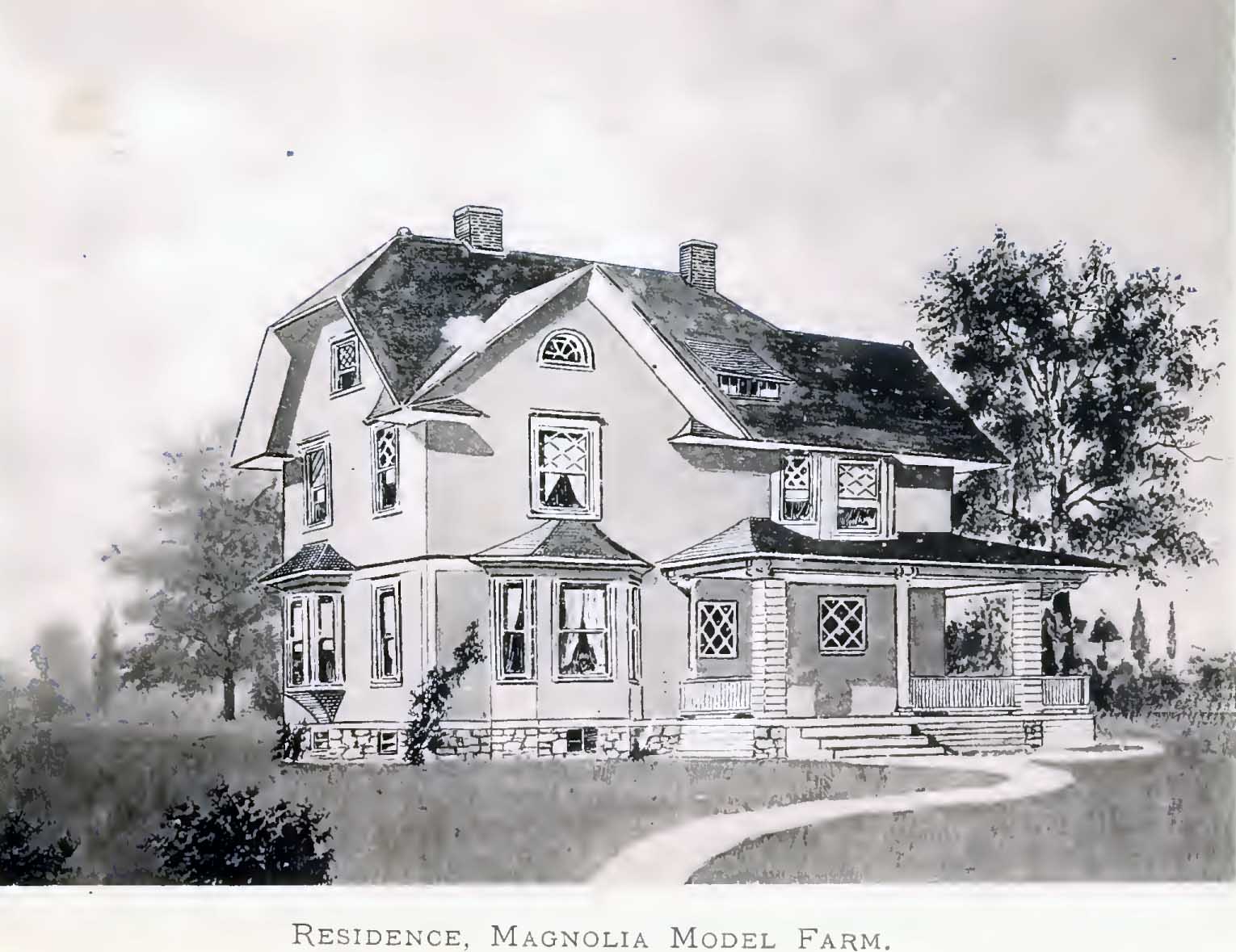
Header variety, to an acre; and 100 bushels of turnips. A Model Farm. Mr. E.E. Clapp, a prominent citizen of New York, and Mr. Herbert W. Lloyd, a well-known nurseryman of Massachusetts, have equipped a model farm adjoining the city limits of Brunswick, which comprises one hundred acres of land, for the purpose of engaging extensively in trucking, dairying, fruit growing, poultry and stock raising. Special attention is devoted to cassava, sugar-cane, alfalfa, velvet beans, Irish potatoes, sweet potatoes and strawberries, as well as garden truck of various varieties. Several acres are to be given to cantaloupes, watermelons, grapes, etc. Pecans, Japanese walnuts, plums and persimmons, peaches, pears, apricots, apples, olives, etc., are to Pg. 38 be largely planted. The barns are to be stocked with the best breeds of dairying cattle, with a view to better develop this industry. A prominent feature also, will be that of poultry raising, to which a large amount of space is to be given. A new and beautiful ten-room house having every modern convenience, faces the boulevard, surrounded by the farm. Artesian wells supply pure water for domestic and irrigation purposes. Truck Varieties. The variety of garden truck embraces a list of products raised in Florida, South Carolina and Georgia, all of which make quick and profitable returns in this vicinity, and especially in this county. The following is by no means the only varieties that can be successfully grown here, for each year new ones are added: Asparagus, Artichokes, Beans, Beets, Corn (sugar), Cabbage, Carrots, Cauliflower, Celery, Cassava, Cucumber, English peas, Egg plant, Kershaw, Lettuce, Leeks, Melons, (See special article), Okra, Onion, Pumpkin, Pepper, Parsley, Parsnip, Pop-corn, Potato, Irish and sweet, Peas, Peanut, Radish, Rhubarb, Squash, Turnips, Tomatoes, Velvet beans, etc. Fruits, Melons, Berries, Nuts. The coast section of Georgia, near Brunswick, produced the Le Conte pear. The first fame of Georgia peaches went out from her coasts. The burden of Oglethorpe’s efforts to colonize Georgia was based upon the fruits that the soil ad climate could yield, and he demonstrated that fact on land that afterwards became Glynn county. Some idea of the liberality of the soil and climate can be gained from the lists of fruits, melons, berries and nuts, successfully grown here now. Mr. Charlton Wright, who has a large farm a few miles north of Brunswick has cultivated fruit and pecan-nuts for several years, and states: “About twelve years ago I was impressed with the possibilities of the pecan industry. I read up, studied the matter, and decided to try it. I thought that if the hickory tree could grow so luxuriantly and prolifically in this climate, and on these soils there should be a strong prospect for the pecan I planted out a number of young trees purchased from a nursery, but they died; I did not give up, however; I tried another plan. I purchased the nuts themselves, getting different varieties, and planted them; they sprouted and grew rapidly. I then transplanted to a field I had laid out for a pecan Pg. 39 grove, and each year afterwards I continued the same plan. When my own trees began to bear I began a small nursery, using the nuts of my own trees, then transplanting them until now I have over 40 acres in Pecans. I find a ready market for every pound. Relative to fruits, about eight years ago I planted out a variety of young peaches and quinces, and added to the number each year. Many of the original trees are standing and bearing each prolifically. Have always been able to dispose of every peach, and always receiving better prices than the peaches shipped from West Georgia. The Elberta, of course, being the favorite. In peach growing I would advise, in order to get the largest possible yield at the smallest cost, for a grower to plant a certain per cent. of new trees each year, and then at the sixth year cutting out and destroying his planting of the sixth year previous. It pays better to do this any way, thereby having a virgin tree with a healthy virgin fruit, rather than to be coaxing the trees to bear heavily each year which they will not do after they are seven or eight years old, as a rule, in this day of nursery stock. My lands are the same as the average Glynn county land. As a paying business I consider fruit and nut growing in this county to be a judicious investment, yielding magnificent returns.” List of Fruit Trees. A list of fruit
trees adapted to this section and county has been published by the
State Agricultural Department, showing the varieties, and in the
following schedule they are given in detail, together with a general
summary of fruits, nuts, melons and berries. Pg. 40 Grapes: Of the nineteen
varieties that thrive successfully in every respect in Georgia,
eight attain their highest state of development in this section and
county; they are the Concord, Delaware, Ives, Norton’s Virginia,
Flowers, Scuppernong, Thomas and Warren. Nuts. The hickory is a native to the climate and the soil, growing to large size and very prolific. The walnut is adapted to these conditions. But for the market growing the Pecan and the Japanese walnut yield quicker returns. The success of the Pecan has long since passed the experimental stage. The Japanese walnut is a new product, and from reports will soon be established as a staple one. Pg. 41 Melons. The summer tourist who has been abiding during the hot months on the neighboring islands for the many years gone by, has spread the fame of Glynn county watermelons and cantaloupes. Now a great deal of attention is given to the extensive growing of the luscious products for the eastern and western markets. The melons raised here are noted for their fine flavor. Berries. The native Georgia
blackberry is at its best growth in this section; they are of a
large size and are easily cultivated. ======================= EXTENSIVE FARMING. The first successful growth of sea-island cotton was made in Glynn county, near where the city of Brunswick is now located, in 1738; the first sugar factory in Georgia was erected in Glynn county in 1820, to manufacture home raised sugar-cane, Georgia at that time holding a high place in that industry. The first successful experiments in Georgia upon an extensive scale in cassava culture was made in Glynn county; the rice grown in this county is of a superior quality, and holds preference in the markets; the acreage yield and quality of corn is magnificent, comparing in every respect with that of the West. These statements of five staple crops that can be grown upon a large scale in the county, and which can be sold as raw products in the markets, or for material for local manufacture: cotton, corn, sugar-cane, cassava and rice, reveal openings for extensive and profitable farming. Rice. The growing of rice in Glynn county for marketing has been in vogue since 1800. The quality of the product places it high in the market, being of unusual fine grade, size of grain, nutritive content and percentage of whole grain. The acreage yield averages 47 bushels. At present there is only about 1,200 acres devoted to rice Pg. 42 culture, and almost entirely along the tide waters of the Altamaha river. There is fully 35,000 additional acres of lands in the county suitable for both the tidal processes of irrigation cultivation, and for the irrigation process by artesian wells and pumping, commonly known as the canal or super-surface system, also as the Louisiana method. There is a strong demand at home and in the West Indies for rice. Sugar Cane. The pine-lands are most inviting fields for sugar-cane culture. An analysis of our sugar cane juice reveals a higher per cent. of sugar content than that of the Louisiana cane, with a profitable acreage yield, netting a better return in sugar manufacture than can be offered at the Louisiana fields. The increasing demand for Georgia cane syrup in itself a strong stimulant for a more extensive cultivation of sugar-cane. The average yield per acre in this county is from 300 to 630 gallons of syrup. There is fully 60,000 acres of land in the county adapted to the successful culture of this product, and range from $2.00 per acre upward. Cotton. Glynn county soil and climate profitably produce Sea-island (long-staple), upland (short-staple), and the Egyptian cotton, with but slight variation in the quality of the fibre. There are 60,000 acres of cotton lands in the county. That large acreage of these three cottons will be profitable investments stands to reason if the crops can be sold to local manufacturers. The strong and growing demand for sea-island and Egyptian cotton manufacturies increases the opinion that factories located in the fields can supply these demands with more economy than the factories that have to either purchase their raw materials hundreds of miles away from its home, or else ship their output hundreds of miles before reaching a market. By the cultivation of these three cottons in Glynn county the producer will encourage the erection of local mills to consume the crops, and who by this saving of freight can pay more for the raw product. The demand for cotton products in the West Indies is but one of the many nearby markets. Cassava. This is a new crop for Gorgia [sic], having been previously known here in a vague way, and not until a few years ago was it recognized commercially in Florida. Perhaps its greatest value lies in its use as a stock food. Extensive experiments Pg. 43 throughout this section has demonstrated its wonderful properties for such purposes, besides solving a problem for an economical crop for large acreage. Taking into consideration the relative low cost of production, with its high percentage of net profit, cassava is not only destined to be, but already has been the inspiration for the extensive development of stock raising for market, both for home and for shipment. In addition to furnishing a food for stock, it is also excellent for poultry and mankind. Relative to its success as a stock food refer to article on Stock Raising. Next to the use of cassava as a basis for the economical feeding of stock, it presents a raw product for the manufacture of an unrivaled starch. Cassava starch is the acme of commercial and fabric starches. Its manufacturing process has passed through the experimental stages, and it is no longer an unknown problem, but now attracts investment. The demand for cassava for this manufacturing has increased the acreage, but even now the supply is entirely inadequate. As a surplus crop to sell to these factories it will bring from $40.00 to $70.00 per acre. Corn. Corn grown luxuriantly with large yields, from 25 to 35 bushels per acre, the average for the state is only 11 ½. 2,000 acres are planted annually, but which is not one-tenth enough to supply the home demand. Lands throughout the county will produce satisfactory yields. Grain, Hay and other Stock Foods. Bermuda, crab-grass, volunteer-grass and beggar-weed have a large natural growth. Hays from these have yielded 10,000 pounds per acre in a season. 80 bushels of rye and barleys own together have been harvested in one season. Rice straw mixed with volunteer and crab-grass affords a good hay. The pea-vines and velvet beans also furnish an almost exhaustless supply of vine hays. Ground-peas yield 30 bushels, and field-peas 20 bushels per acre. These hays with cassava and corn furnish an abundant as well as low cost stock foods. Other crops. Broom-corn. Experiments in this section have proven that broom-corn of a good commercial quality can be profitably grown here, thereby offering a source of supply to local and nearby manufacture. Pg. 44 Tobacco. Tobacco has been grown in the county for years, but not for marketing purposes. Counties adjacent to this have placed excellent grades upon the market. There is no reason why an extensive tobacco culture would not yield satisfactory results. ================ FERTILIZERS. Commercial fertilizers are seldom used in Glynn County, [sic] The alluvial deposits that have been accumulating for centuries from the interior, and have been spread out by annual overflow of the rivers, or gathered up by the ocean tidal-currents and formed into the large areas of marshes, yield a production that has been found to be an excellent soil enricher. These marsh-mucks and hammock-mucks, as they are commonly called, contain elements of decomposed and thoroughly mixed vegetable and organize matter, and when plowed into the loamy soils, then followed by ordinary cultivation, cause highly productive yields of all suitable crops. Deposits of marl are also found in many places, which form an excellent fertilizer. The addition of stable, cow-lot and barn-yard manures to the natural condition of the soil constitutes the greater percent, of present methods. =============== IRRIGATION. Nature has not only supplied Glynn county with a liberal variety of soil of the best quality for successful agriculture, and a sympathetic climate, but has added to these a wonderful and unlimited supply of pure water for drinking and irrigation purposes. The zenith of success in raising and marketing all classes of truck is to have never failing crops, and in order to be assured against failure is to be prepared to utilize artificial rain, in other words to irrigate. While without irrigation all spring, fall and winter crops are a certainty, yet the fickle summer-weather almost cuts off the raising of truck after the latter part of June and up to October. But by irrigating and care, large crops can be raised during the summer days. Underlying the Pg. 45 soil from eighteen to forty feet are good waters, and while suitable for all domestic purposes, also furnish a source for irrigation. These streams are reached by pumps being driven into the ground-yielding earth (well digging is an uknown process here), and can be pumped into tanks by wind-mills or small engines. But generally this cost is almost as great as that of sinking artesian wells. All the artesian wells in this section are self-flowing, rising to a height of 40 feet above the soil with a 50 pound pressure to the inch. The subterranean reservoirs affording this inexhaustible supply are reached at a depth from 250 to 330 feet, known as the first supply, then again from 350 to 475 feet, the second supply. This latter is stronger in pressure, and impregnated with more mineral matter. These wells are sunk by local experts who guarantee a flow as above stated, at a cost ranging from $250 up, according to size of pipe and depth of well. Owing to the comparatively level lay of the lands throughout the county, yet with a natural drainage, the problem of trenching and ditching is reduced to a minimum. A system of above surface sprinkling, similar to the lawn sprinkler, has proven to be a decided success also. ====================== LIVE STOCK. Mile after mile of undulating lands covered with a forest growth of pine, oak and other trees, affording ample shade, while in the low places running streams offer an abundance of drinking water; and having an adaptable soil for cultivation, yet at all times carpeted with a natural growth of wire-grass, Bermuda, crab-grass, beggar-weed and other native grasses, is a true description of the cattle ranges throughout the county, and whereon is needed more stock to graze and prepare for a market right at hand as well as for shipment. These natural conditions can be greatly improved by the cultivation of special food-stuffs as cassava, velvet-beans, ground-peas, cow-peas, corn and grain; the harvesting of the natural hay crops; and the breeding of better stock than the natural scrub-stock at hand. No other movement has received such prominence and success as this industry within the past few years. The favorable results in the growing of the native stock, with its profitable marketing, with a stronger Pg. 46 demand for larger sizes, has greatly stimulated
this important enterprise. The feature of low-priced lands, natural
growih [sic] of plant-food grasses, cheapness of cultivation of
other economical food-plants, climate conditions, excesses of
neither heat nor cold; abundant labor at reasonable prices; ample
transportation facilities by both rail and water; and a market
within a minimum distance. Relative to cassava as a stock-food a
prominent breeder states: 1 steer, weight 500 lbs., at 2
cents……………………………….………………….$10.00 100 days average gain per day, 3
lbs……………………………………………300 lbs. Selling price at 4 cents per lb…………………………………………….$32.00 making the difference between $32, selling
price, and $16, cost, per steer, or a profit of $16 in 100 days’
feeding or 100 per cent. Pg. 47 POULTRY AND EGGS. The local consumption of poultry and eggs is far in excess of the local supply. Immense quantities of chickens, ducks, guineas, geese, turkeys and eggs are shipped into Brunswick each week. Yet invariably success has been attained by those who have gone into this industry here. At the Southeastern Fair, held in Brunswick in November, 1899, the exhibit of Glynn county raised fowls of various kinds afforded a practical illustration of what can be accomplished in raising for market and breeding purposes. Mr. Fred Baumgartner and Mr. Louis Mayer have been highly successful in their efforts; and there is not a farmer who has not his broods of chickens, turkeys, ducks, geese, with their eggs, but only brining his surplus to a market that is anxious for more home-raised products. Not only is the local market demanding those products, but there are excellent opportunities for shipment to Florida and other points. DAIRY AND CREAMERY. There are five dairy farms supplying the needs of the city. The cows are mostly of the Jersey breed. None of the dairies make a specialty of cream, butter, butter-milk, cheese, or any bi-products of milk. But a very small amount of these products are made in the county, although the demand is unusually large for the size of the city. These products, when of home manufacture, bring a premium on the market price. The demand for creamer has been steadily increasing until now there is an excellent opportunity for one. Large, natural ranges for cattle, favorable climatic conditions, and labor, with home-raised foodstuffs, afford a condition that should be an inducement. APIARY. Bee culture has been undertaken on a small scale for several years, and has proven highly profitable. The local market consumes large quantities and prefers the local product at a premium. Pg. 48 FISHERIES. In addition to the yielding properties of her varied soil, Glynn county is bounded and pierced by fully two hundred miles of inland water-ways, both salt and fresh, and while affording navigable channels by which truck is brought to market, they produce a wide variety of fish kind. Oysters. There are over 50,000 acres of oyster beds in the county, and about one-half of which are partly cultivated and protected. The Glynn county, or better known as the Brunswick oysters, are of a superior quality, and command a premium in the markets. Thousands of bushels are shipped to the interior markets each season; and the two canneries pack and ship 30,000 cases of oysters annually. This industry affords excellent opportunities for further development. Terrapin. The terrapin industry is one of great importance in the county. The demand for this epicurean delicacy cannot be supplied at present. Three hundred dozen were shipped from here during the past season to the eastern markets. Shad. The waters of the Altamaha river on the extreme northern limit of the county furnish an almost exhaustless supply of roe-shad. The strong demand for shad in season offers an opportunity for a better handling of this industry. The seasons’ catch in the state amounts to $46,000, with a preference in this particular specie. The Satilla river product is also large. Sturgeon. The same waters supply the market with sturgeon. This industry is also in position to be better developed. The annual catch amounts $4,060 in the state. Pg. 49 Other Fisheries. The
miscellaneous fisheries comprise oysters, crabs, shrimp, clams,
terrapin, turtles and an endless variety of marketable scale fish as
bass, snapper, trout, bream, perch, flounder, blackfish, yellow-tail
whiting, drum, young-drum, sheephead, angelfish, Spanish mackerel,
skipjack, silverfish, mullet, tautog, catfish (fresh and salt water)
sucker, eel (fresh and salt water), grouper, croker, etc. GAME. The deer that the Indian stalked in the days before the advent of his pale-face successor have descended by undiminished generations through the years, and still remain as fleet as ever, as timid as ever, and the game of game. In the thickets of the forests of the county many are shot each season, affording a luxury of venison dishes. Then there is the quick and alert squirrel, the rabbit, the “possum”; among the winged game is the quail, or partridge, the dove, the rice-birds, the wild goose, turkey, and various ducks. A little pamphlet issued by the Southern Railway truly states: “In Georgia the shooting opportunities along the coast have attained unusual distinction and repute because of preserves like Jekyl Island and other resorts of wealthy men who are fond of rod and gun. Brunswick is the center of this life.” RAW MATERIALS. The available amount of raw material in the county for market demand and as a base, or auxiliary, for manufacturing purposes, comprise, timber, clays, fibre, sand and medicinal herbs. Pg. 50 Timber. A survey just made of this county alone shows that there are 5,000,000 feet of cypress, 10,000,000 feet of sweet gum, 5,000,000 feet of beech gum, 3,000,000 feet of white oak, 3,000,000 feet of ash, 5,000,000 feet of post oak, 5,000,000 feet of live oak, 1,000,000 feet of hickory, and 10,000,000 feet of pine, 2,000,000 feet of palmetto. A total of 49,000,000. Clay. There is an abundance of brick clays in many places, convenient to water and railroad transportation. They are located at points beginning six miles from the city. Fibre. The ever-present scrub-palmetto and cabbage-palm supply an excellent fibre, which is made from the long leaves, and highly suitable for upholstery purposes, mattresses, packing and for moulders’ cores, also for brooms and brushes. A ton (2,000 pounds) of leaves will yield from 800 to 900 pounds of fibre. Spanish moss, an air-plant that grows luxuriantly upon the trees, is also an excellent fibre for mattresses, packing and general upholstering purposes. The wire-grass growing everywhere throughout the county is used in the manufacture of door-mats, baskets, and is suitable for ropes, etc. The marsh grasses are also used for basket and mat manufacture. Sand. There are exhaustless deposits of sand in the various streams that is adapted for building purposes of mortar and cement work; for tile manufactury, and for roof covering, and available sands for glass manufacture. Herbs. Among the medicinal and commercial roots and herbs in available quantities for marketing are yellow Jessamine, Jerusalem oak, poke root, sassafras root, sun-flower seed, deer tongue, wild cherry, prickly ash, etc. |
Home
Contact
Site Map
Copyright ©GlynnGen.com All Rights Reserved
Material on this site is one of kind,
having been published here for the first time ever. This data was compiled by
Amy Hedrick
for the GlynnGen website to be used for your personal use and it is not to be
reproduced in any manner on other websites or electronic media,
nor is it to be printed in any resource books or materials. Thank you!
Want to make a contribution?
Donate via PayPal:
 Pg.
9
Pg.
9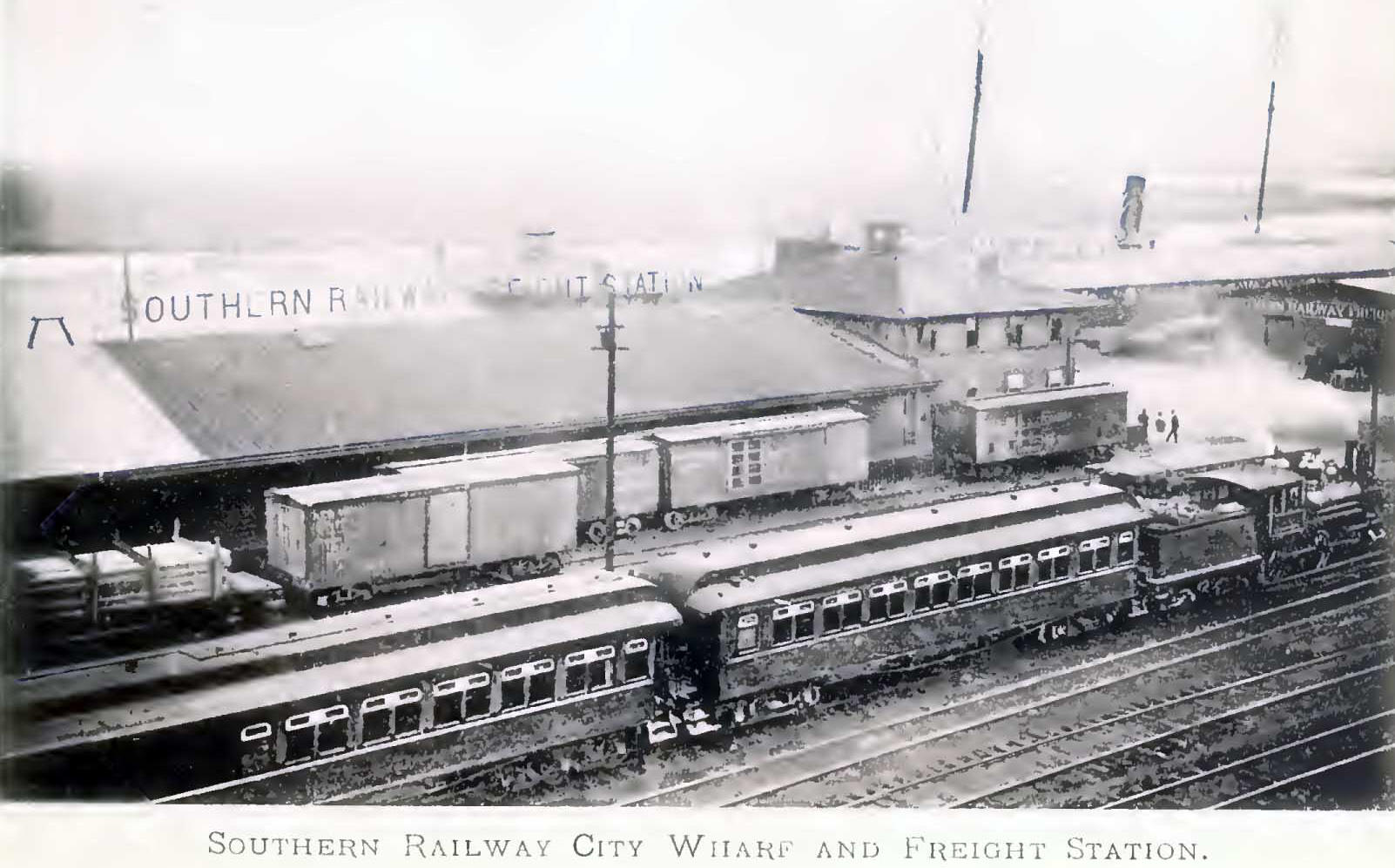 Pg.
11
Pg.
11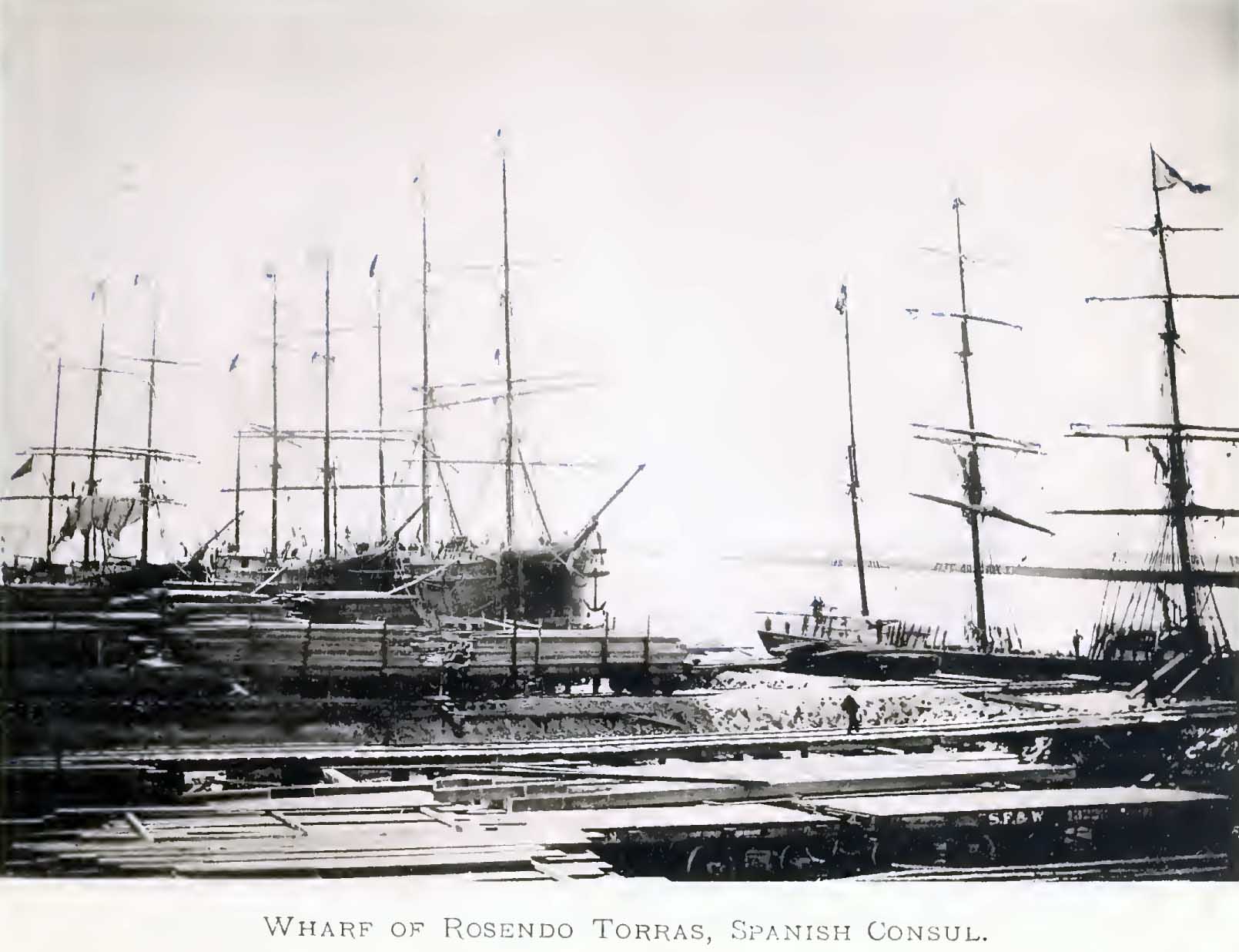 Pg.
13
Pg.
13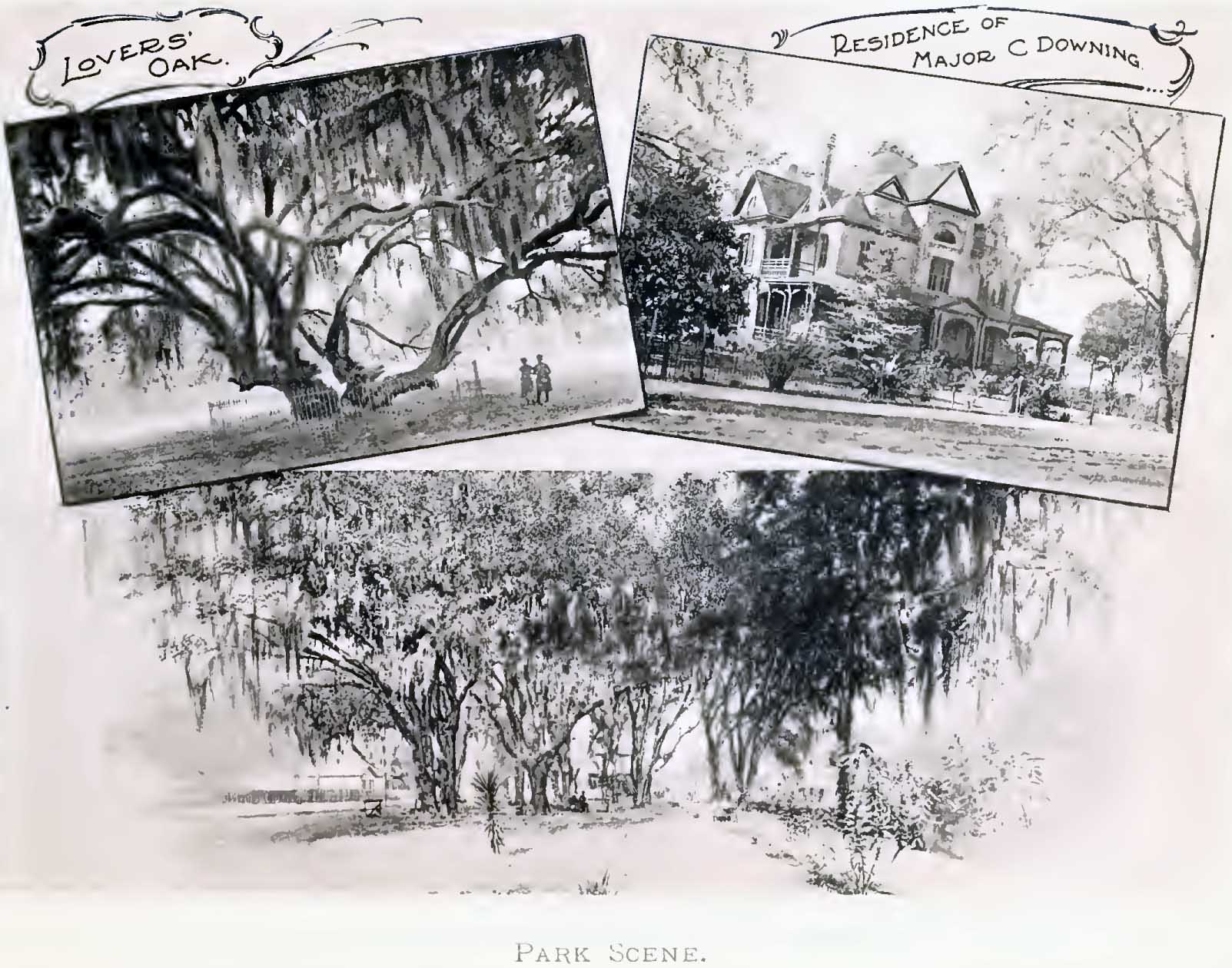 Pg.
14
Pg.
14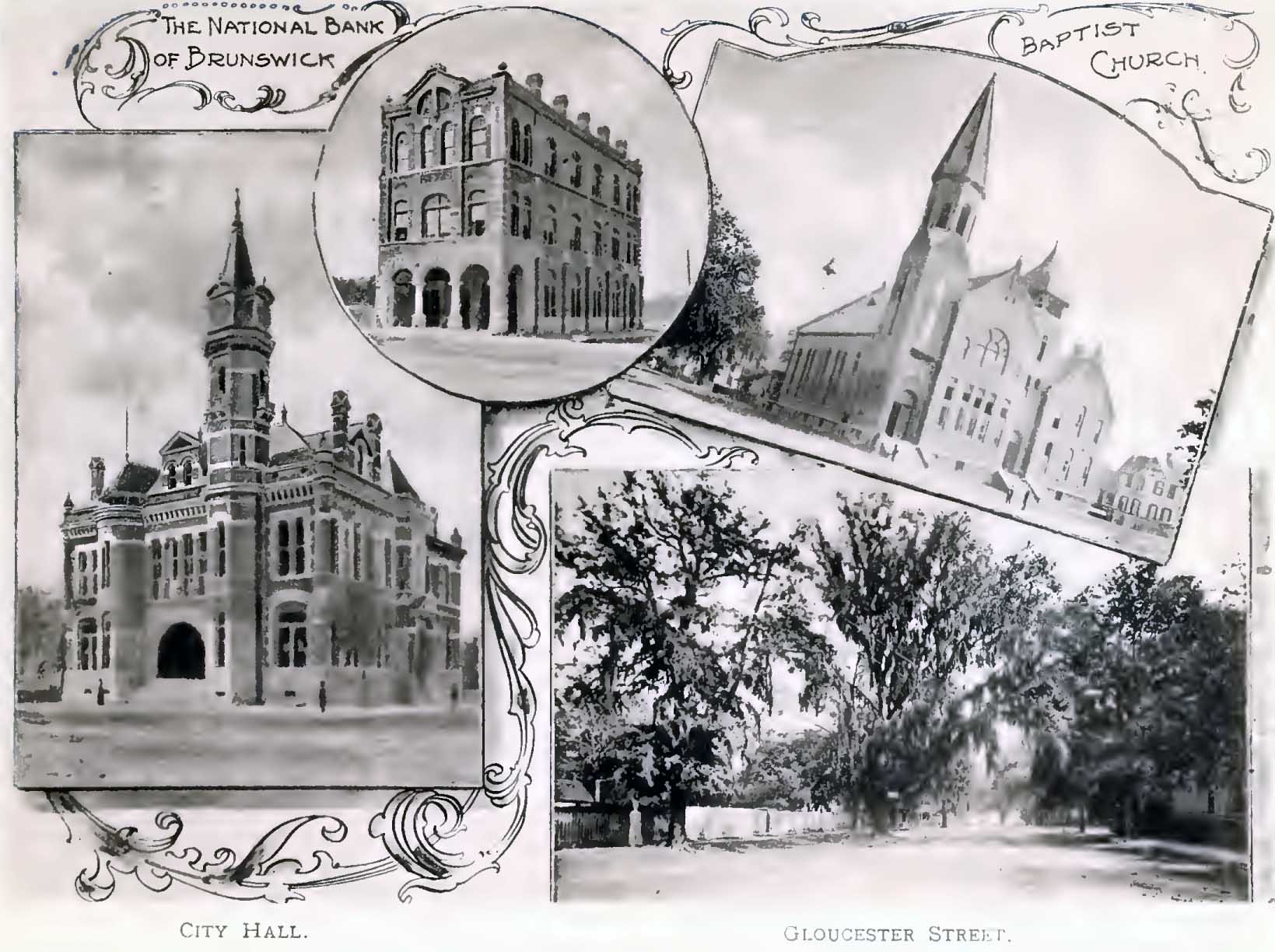
 Pg.
15
Pg.
15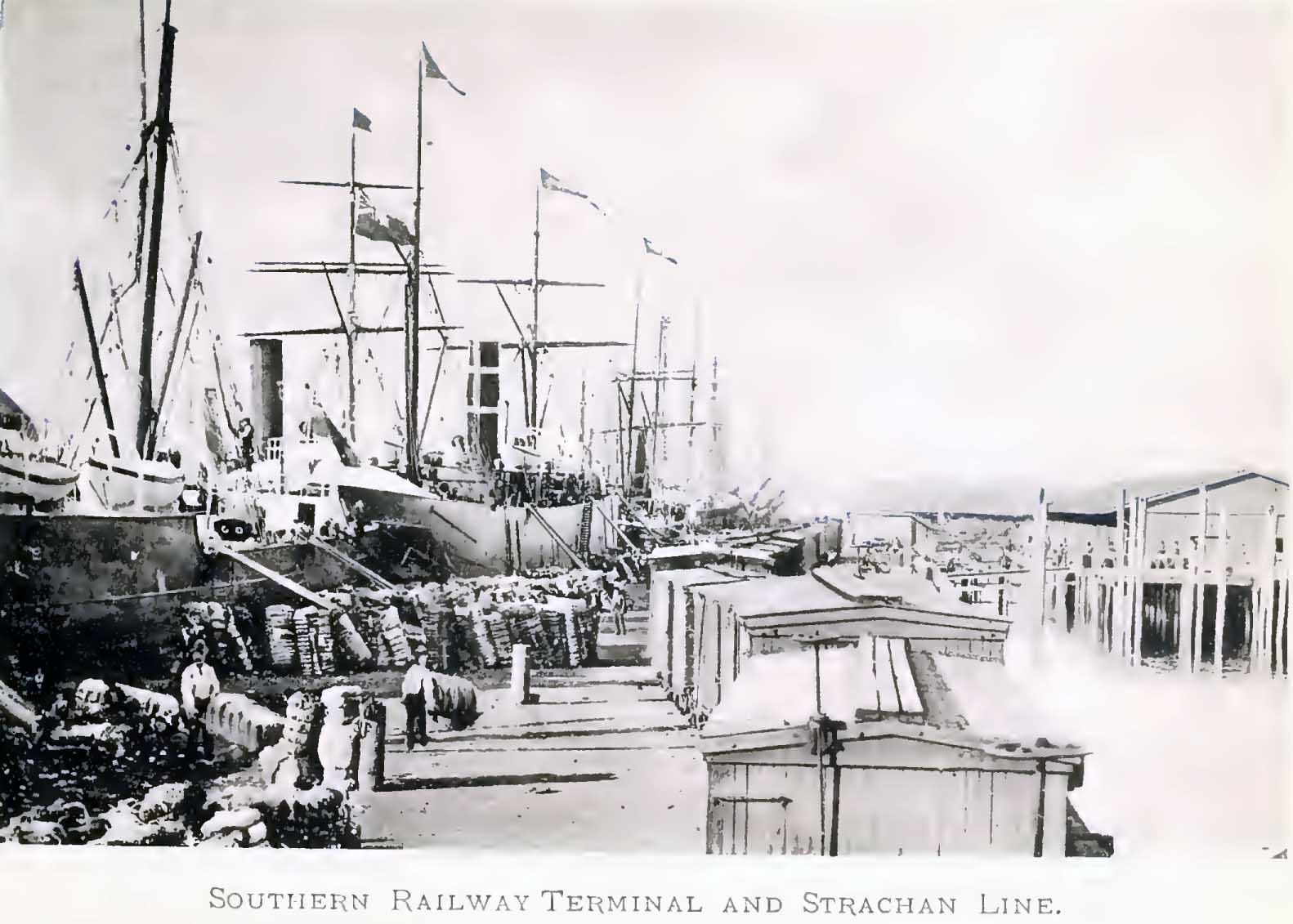 Pg.
16
Pg.
16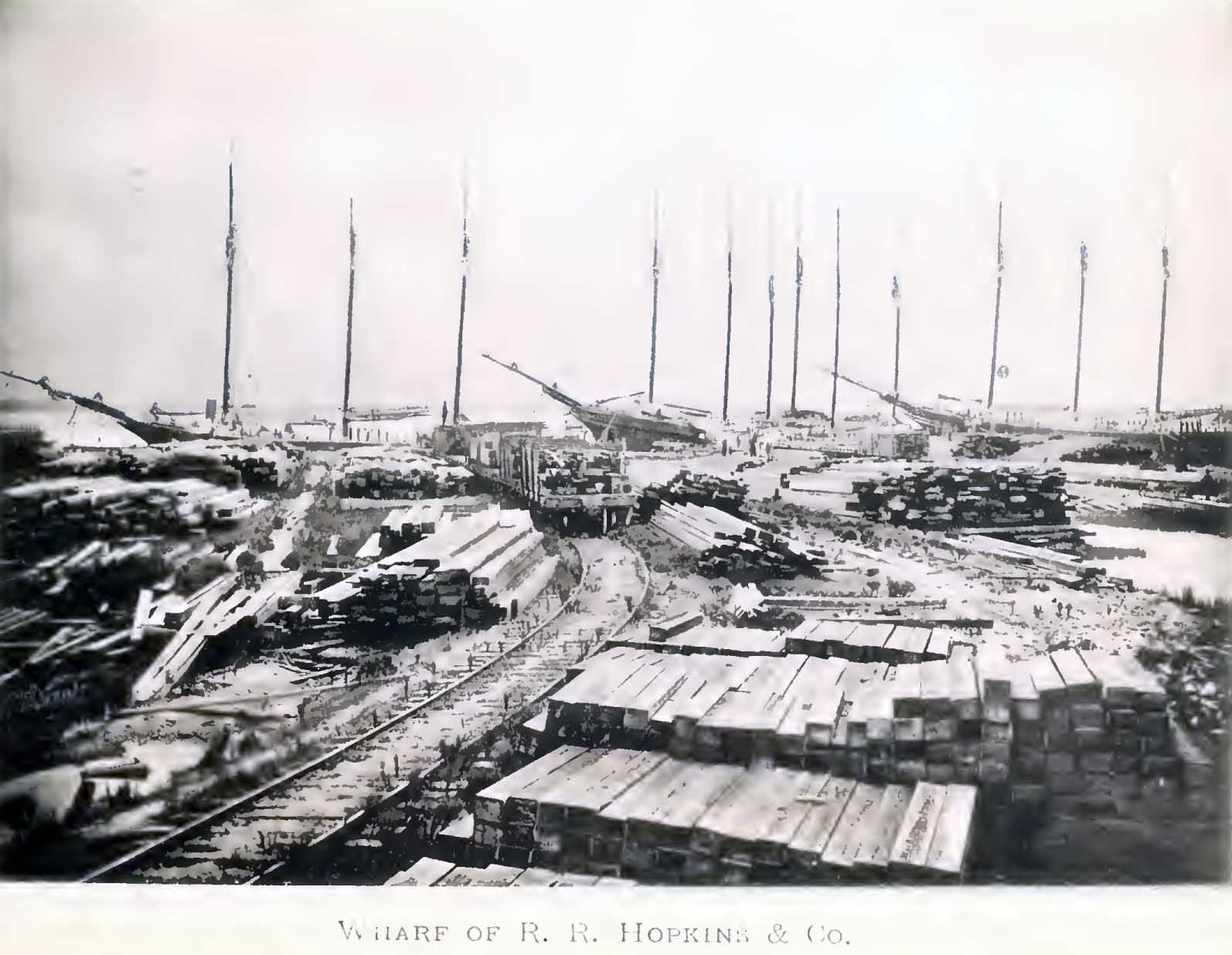
 Pg.
18
Pg.
18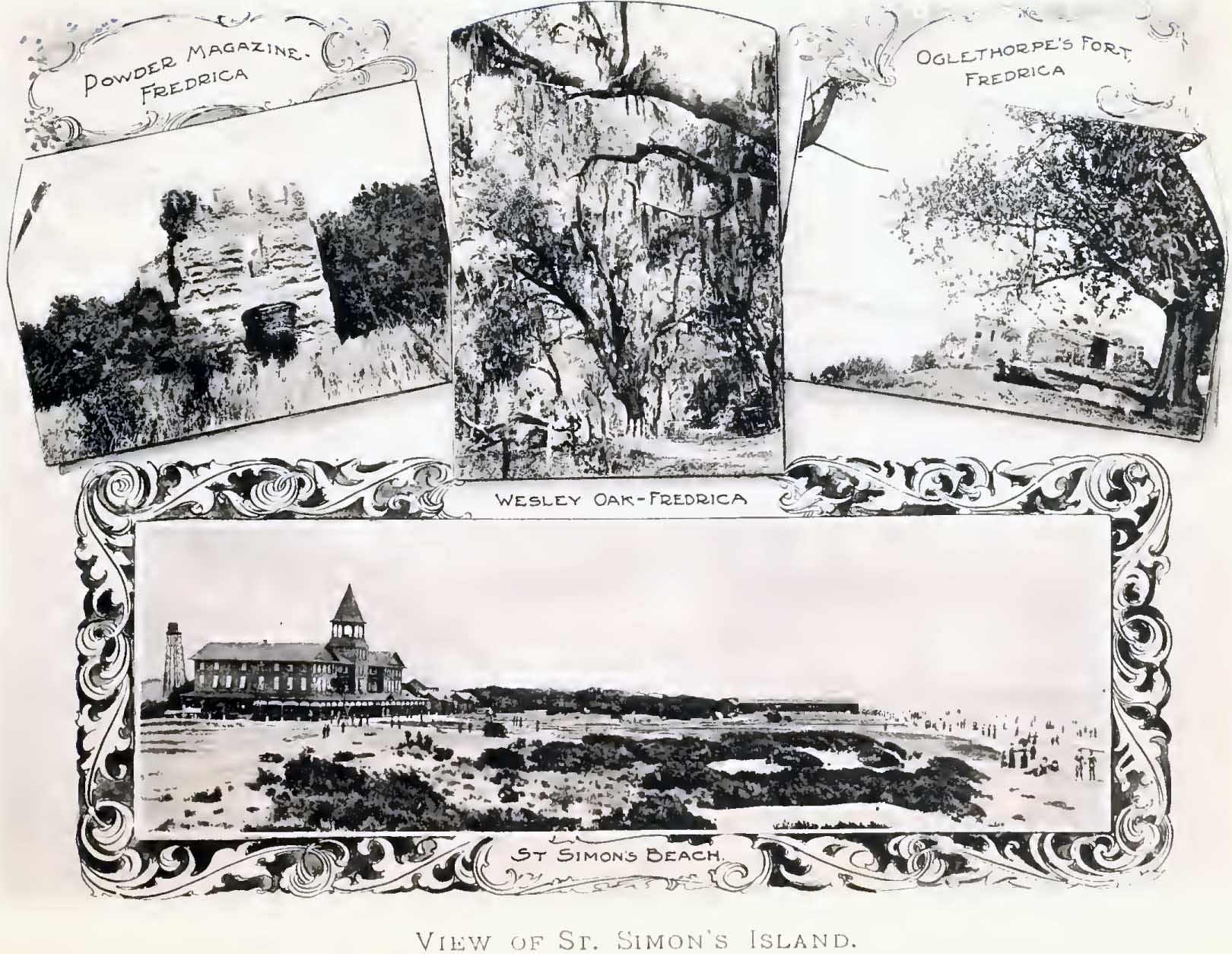
 Pg.
20
Pg.
20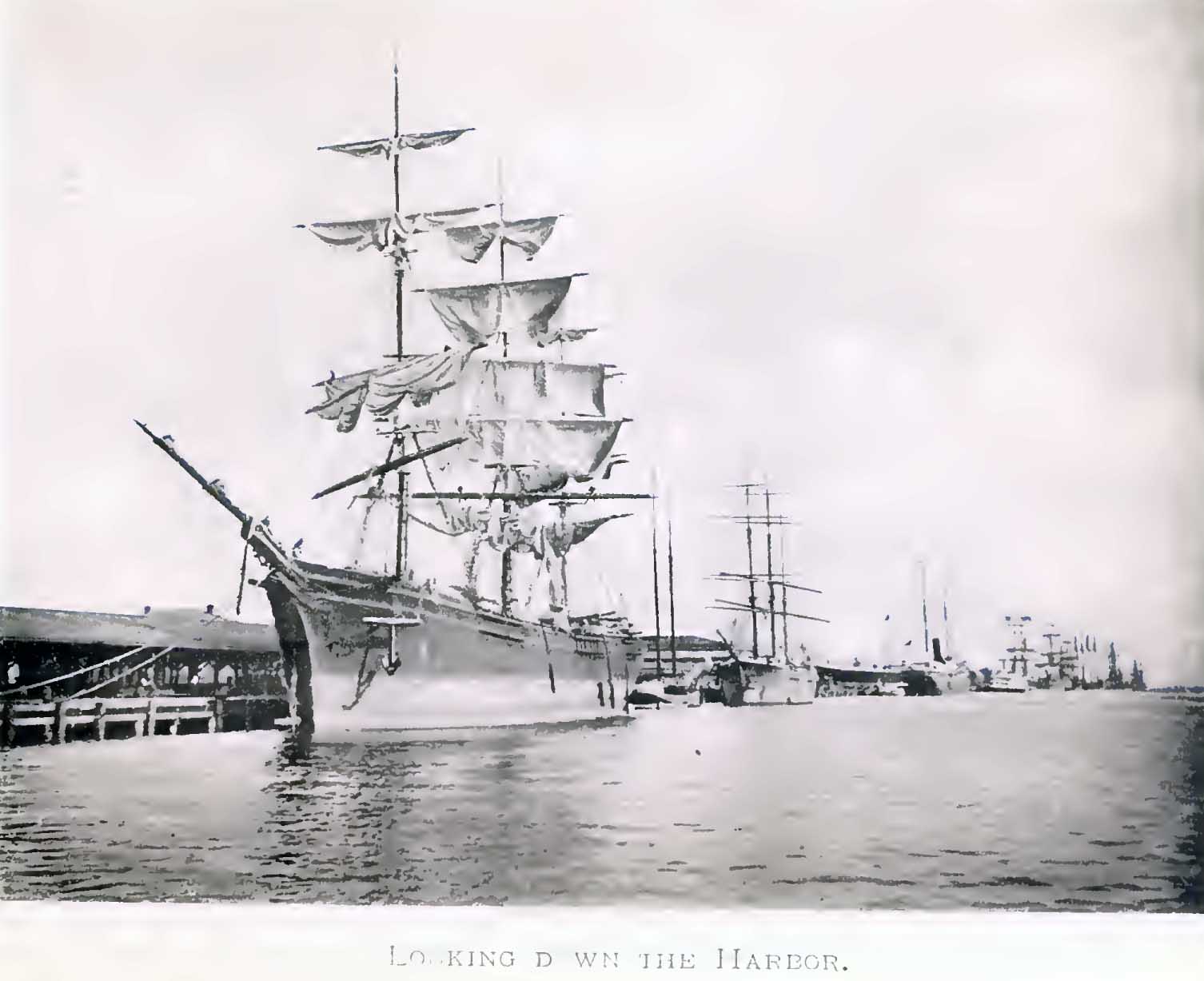
 Pg.
22
Pg.
22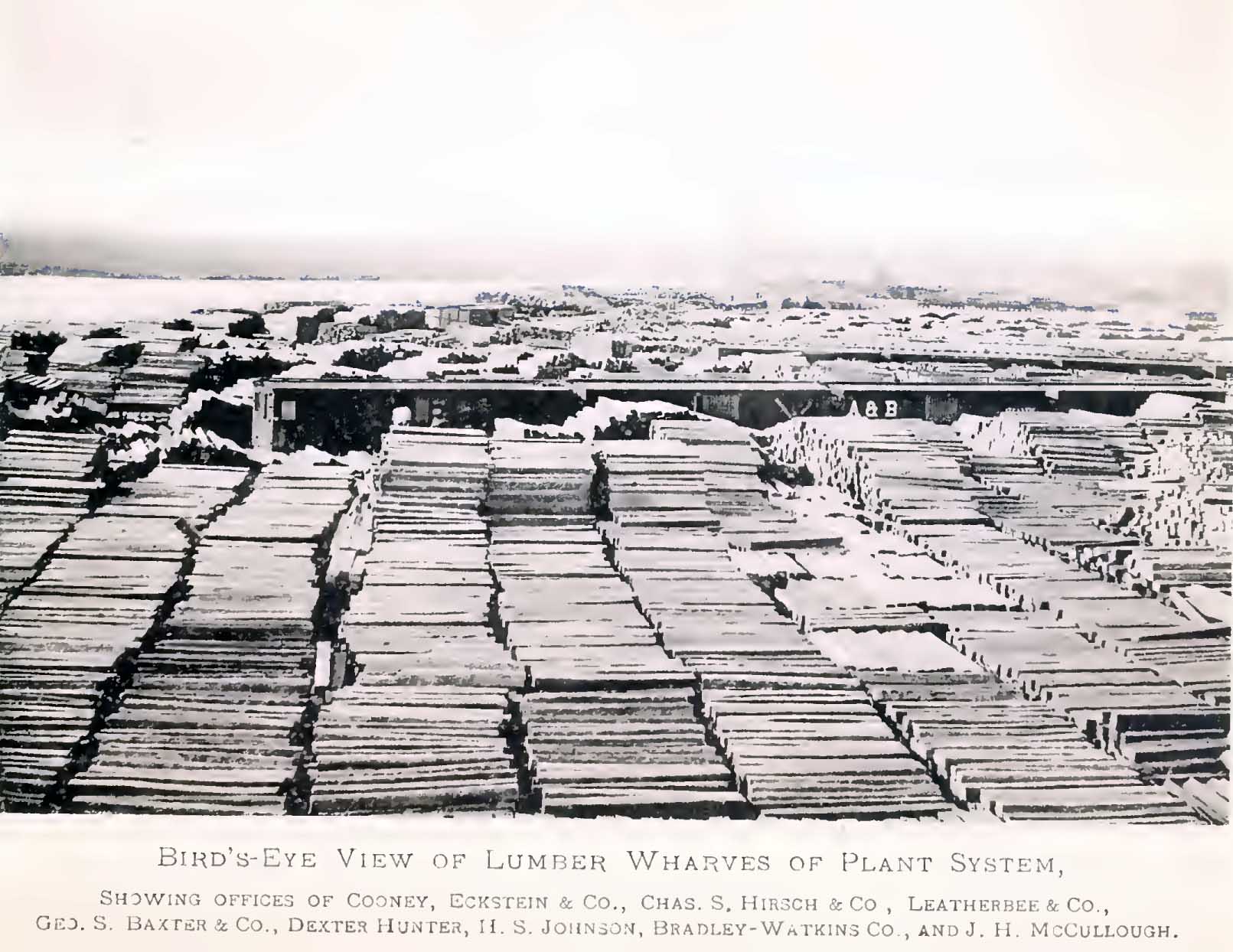
 Pg.
24
Pg.
24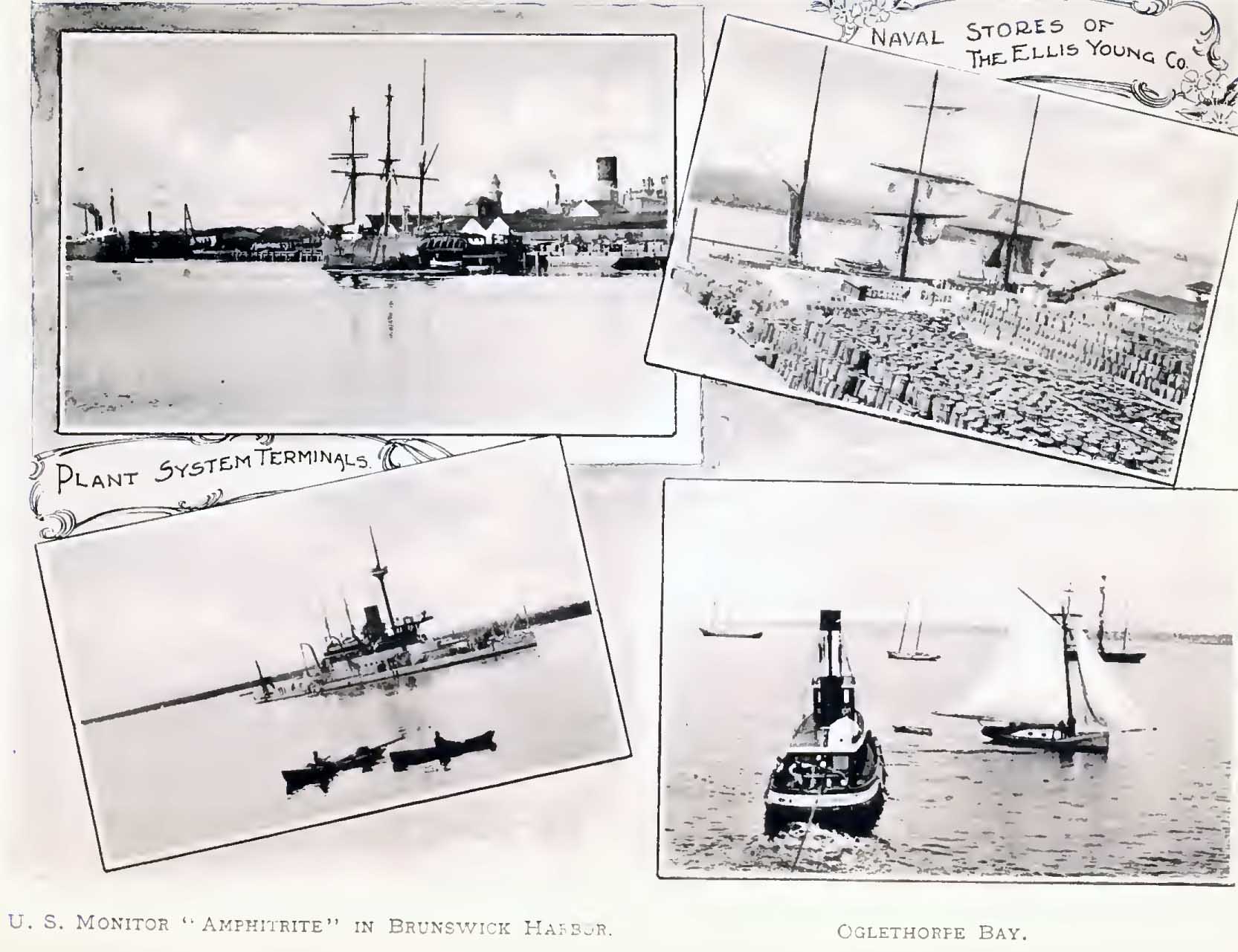 Pg.
26
Pg.
26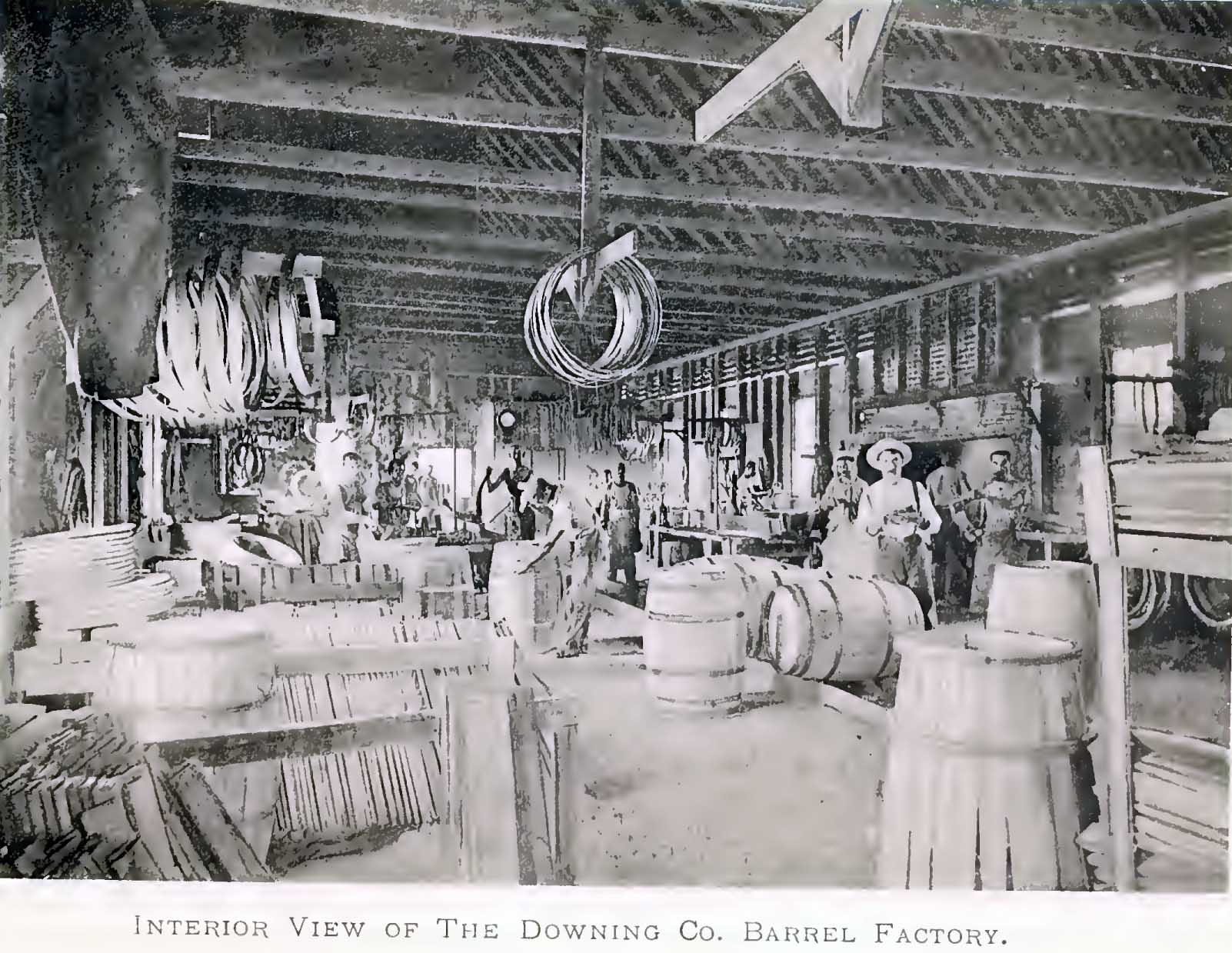 Pg.
30
Pg.
30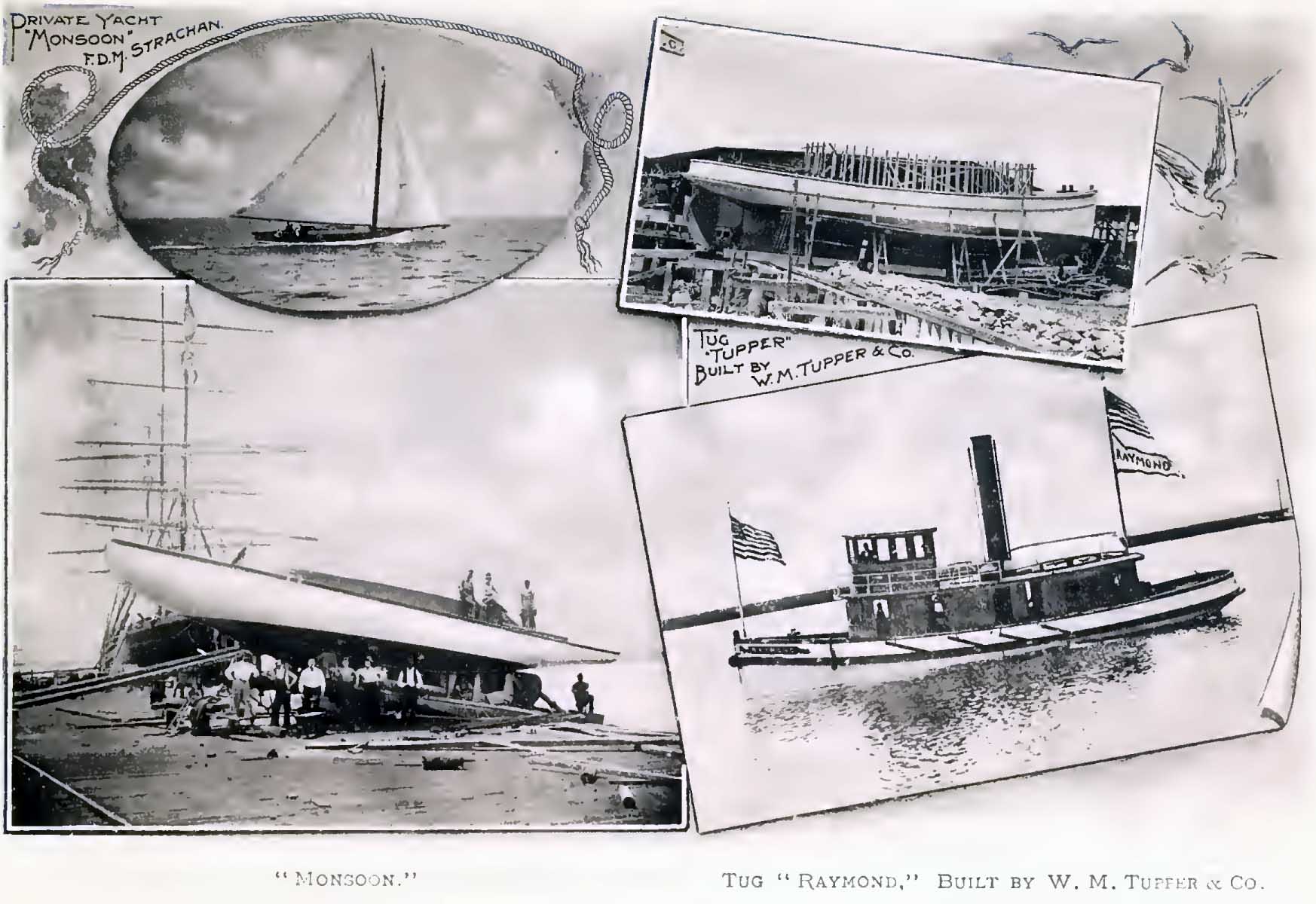
 Pg.
36
Pg.
36