|
CUMTUX
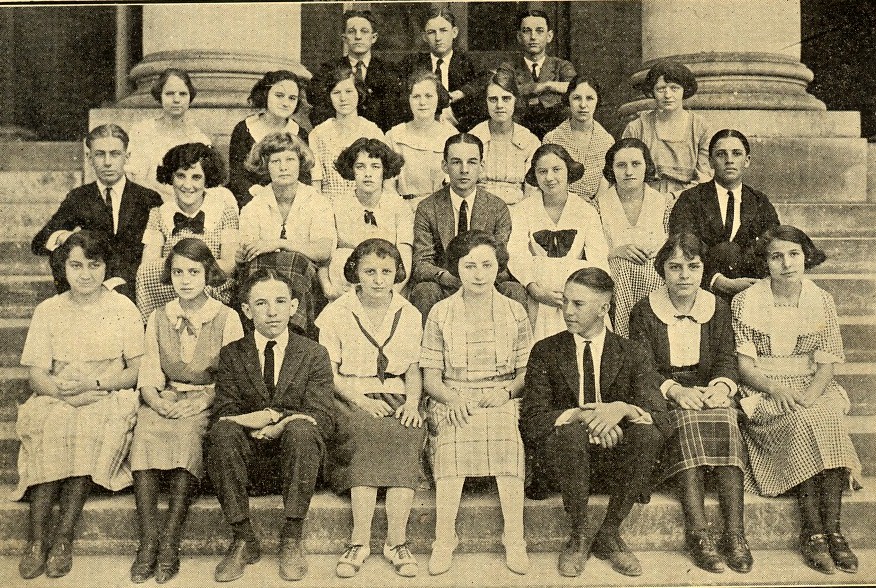
Seniors pgs. 8-41
lower classmates are pictured too
If you know who is pictured where, please let me know!
|
pgs. 8 & 9

Click to enlarge
photo!
CLASS OFFICERS
Henry Beach, President
Elizabeth Harris, Vice-Pres.
Dolores Artau, Sec. and Treas.
MOTTO:
"Be sharp, be natural, but never be flat."
|
COLOR:
Green & White |
FLOWER:
Daisy |
CLASS ROLL:
| Dolores Artau |
Henry Beach |
| Kenneth Bell |
Cornelia Leavy |
| Sarah Blitch |
Eloise Leybourne |
| Tillie Borchardt |
Helen Lissner |
| Ed. Bruce |
Jewell Mitchell |
| Charlotte Carruthers |
Joanna Newman |
| Carrie Belle Dickinson |
Bernard Owens |
| Margaret Flanders |
Mary Parker |
| Mary Gignilliat |
Louise Pfeiffer |
| Alice Kenner |
Albert Smith |
Wallie Konetzko
3rd row 6th person |
Judson Smith |
| Daisy Lazarus |
Jacob Wengrow |
| Elizabeth Harris |
Ray Whittle |
|
|
pgs. 10 to 13
Who's Who in the Class of 1922
Secretary-Treasurer of Class.
Member of the High School Orchestra & Glee Club.
"A gentle voice, a lovely face,
A charming manner and winsome grace." |
|
Salutatorian.
Accompanist High School Orchestra.
First honors in music at District Meet.
"Music hath charms to soothe the savage breast." |
|
"Whenever in doubt, ask Sarah." |
|
"And still we gazed and still the wonder grew
That one small head could carry all she knew." |
|
"Fain would she climb, but that she feared to
fall." |
|
"Be silent always when you doubt your sense,
And speak, tho sure, with seeming diffidence." |
|
"Precious things are put up in small packages." |
Vice-President of class of 1922.
"Strength and honor are her clothing, and she
shall rejoice in time to come." |
|
"Nothing lovlier can be found in woman,
Than to study household good." |
|
"A daughter of the gods, divinely tall." |
Capt. of Basketball Team.
Cheer Leader.
Member of Orchestra and Glee Club.
"A smile for all, a welcome glad,
A jovial coaxing way she had." |
Valedictorian.
Accompanist for Glee Club.
On THE CUMTUX Staff.
"Neat and trimly dressed,
Fresh as a bride." |
Manager of Basketball Team.
Member of Glee Club & Orchestra.
"Come and trip it as you go--
On the light fantastic toe." |
Member of Glee Club & Basketball Team.
President of "Sigma Tau."
"A curly headed little girl,
A mischief making monkey from her birth." |
|
"True expression, like the unchanging sun,
Clears and improves what e'er it shines upon." |
First honors in essay contest at District Meet.
"Her voice was ever gentle and low,
An excellent thing in woman." |
|
"What e'er she did was done with so much ease,
In her alone 'twas natural to please." |
Member of Basketball Team, Orchestra & Glee Club.
"The joy of youth and health her eyes displayed,
And ease of heart her every look conveyed." |
First honors in essay contest at District Meet.
"From his cradle
He was a scholar and a ripe and good one,
Exceedingly wise, fair spoken, and persuading." |
President of Class of 1922.
Member of Basketball & Baseball Teams.
Member of Glee Club.
"He may not be much in a class of English,
But on the basketball court he is always distinguished." |
Editor-in-Chief of CUMTUX.
Member of Glee Club & Basketball squad.
Treasurer of Athletic Association.
"There goes the parson, oh illustrious spark!" |
Member of Baseball squad.
"A merry student is this lad,
His hearty cackle makes all glad." |
Member of the Basketball squad.
Member of Glee Club.
"Roll on old world, and I'll roll with you." |
President of Athletic Association.
Member of Glee Club.
"Why do today what you can put off until tomorrow?" |
|
"His years but young, but his experience old,
His head unmellow'd, but his judgment ripe." |
|
"An unsurmountable objection to any kind of
profitable labor." |
|
|
pg. 13 to 18
History of Class of '22
In the beginning was
formed a class, and the minds of the members of this class were
without form, and void, and darkness was on the face of each.
And a spirit of awe moved among the members.
And the Authority said, "Let there be light," and there
was light, and the light divided some letters of the alphabet from
the other. Some the Authority called vowels and others called
he consonants. And the Authority said "make thou words with
the vowels and consonants and learn to spell these words; the class
accordingly learned that C-A-T spelled CAT and R-A-T spelled RAT.
And the Authority said, "Let the numbers be a part of thy
knowledge," and it was so. The class learned that 1+1=2 and
16-4=12 and 10x5=50. And the authority saw the light on the
faces of the members, that it was good, and the morning and evening
were the primary years.
And the Authority said, "Let they Mathematical
knowledge be applied to Long Division, Fractions, Decimals,
Proportion, Interest and Partial Payments. Learn thou the
rules of Grammar, and let there be knowledge concerning Geography
and the past events in the lives of nations." And the
Authority saw that the increased light was good, and the morning and
the evening were the Elementary grades.
And the Authority said, "Let there be gathered together
at this moment the mortals of the two schools in the beginning of
their High School Course, and let more knowledge appear." It
was so, and the Authority said, "Let the class continue their
studies of the grammar grades and begin the studies of deeper
significance." And it was so, and the class studied Latin, and
Spanish, and Algebra, and the science of cooking, and the art of
sewing; and the Authority saw the increased light, that it was
good--and the morning and the evening were the Freshmen Year.
And the Authority said, "Let there be a light in the
brain, and let it be for Caesar, and for Ancient History, and all
the English rules, and the classics of ancient writers." And
it was so, and the morning and the evening were the Sophomore Year.
And the Authority said, "Let the class continue to
labor and to do good work, to labor diligently with Cicero and Plane
Geometry, and the more recent events in the lives of nations.
And let them study intensely the classics of Macbeth and Caesar, and
bring forth oratorical skill in the debates of Macbeth; and let them
thrash it out among themselves, which of the two villains was more
villainous." And the Authority looked upon the work that had
been accomplished, and saw that it was good. And the evening
and the morning were the Junior Year.
And the Authority said, "Let the Scientist bring forth
the peculiarities of every living creature after his kind," and it
was so. And the class learned everything in the history of our
Republic, and translated the book of Virgil from the dead language
of Latin to the English tongue. A few of the braver members
tackled solid Geometry and Trigonometry, while all the members were
compelled to acquire the knowledge concerning Samuel Johnson and to
read carefully the Orations of Washington and Webster, also to study
American authors from John Smith to the very latest of our
celebrities. And the Authority saw everything that was done,
and behold it was very good. And the evening and the morning
were the Senior Year.
Thus the education of the class was finished. And on the ninth of
June, the Authorities ended the work which they had begun, and the
class rested on the tenth day. And the class had longed for
the tenth day, for in it they would rest from all work.
ELIZABETH HARRIS, '22 |
§
|
CLASS PROPHECY
It was the last meeting of
the Class of '22. Our diplomas had been delivered and as we
held them, each was wondering what the years ahead would bring to
each of us.
We were all wearing a daisy, our class flower, in honor
of the occasion. I was looking at mine and noticed it had an
unusual number of petals. There was such a profound silence
that I counted the petals for lack of something else and found it
had exactly twenty-six. Of course this meant something to a
class which had always remembered dates and significant numbers
without the slightest trouble!
Thinking I would try my own fortune I pulled off one of
the petals. I jumped up and uttered something about a name.
Of course everybody laughed and the spell was broken.
"Listen," I cried, "if that isn't
Dolores Artau
written right on this petal, I'm seeing things."
They all agreed. There was a picture or
impression on the petal, too, and everybody crowded around to see
it. It showed a girl playing a violin in the midst of an
animated group. We recognized Dolores, our little
Spanish member, and the posters told us it was Madrid, Spain.
Dolores' violin was speaking the thoughts she had gathered
back at old Glynn Academy. Dolores had become the idol
of old Madrid!
The next petal was pulled off an we saw it belonged to
Henry Beach, but the name showed us the prefix of
"Honorable"; he had not changed, the first thing he did was to say,
"I spec' this man is innocent." The jury must have thought the
same thing for they freed the victim. It seemed this was what
always happened when Henry argued a case.
The next picture was a little lady wit her hair in a
knot on top of her head, and she was saying to a room of children in
front of her, "Now, children, when I went to school in the old
academy we did--------------------"; it was
Charlotte.
Not every picture had a name on it and
we thought it made it more effective, as it certainly did in the
next case.
A man was looking at a book with the title "Authority
on Dress," by Madame Perrichon. The gentleman said musingly,
"My best work--now indeed shall I become famous." He lifted
his head and the picture faded but we had recognized Ed. C.
Bruce, Jr.!!!
We saw an office door next, and on it was inscribed
"The Bell System of Laundries--President's Office." As we
expected we saw Kenneth appear. He was sitting at a big
desk giving dictation to a stenographer. It was just such a
thing as we had always expected him to do.
The next petal disclosed the front of a cozy little
shop on which was written in dainty letters, "Togs for Tiny Tots."
And the next the interior of the shop. It was as neat as a
pin, with all kinds of pretty things hanging around, but the most
orderly objects were the two ladies who sat sewing on two tiny
dresses. Through the years they had come--Carrie Belle
and Wallie--the "inseparable pals."
On the next petal was the imprint of a big hall and
many distinguished looking men and women. The two central
figures were in the midst of a heated discussion. Helen was
telling Ray that she would help him in this desire if he
would help her put thru her bill. Ray had already
turned his eyes toward the White House that stood not far away.
Helen was then told to read her measure which was in the form
of a resolution She read it in a sonorous voice, "Be it
resolved, that, for the protection of the womanhood of America,
every house shall be searched by local officials, and in every one
where a rat or mouse is found, the owner thereof shall be prosecuted
to the fullest extent of the law." Of course it took two petal
for this as it concerned two pupils.
The next picture was what made us sit up and take
notice. It showed an operating room and two white robed
figures conversing. We discovered from what they said that a
serious operation was about to be performed on the heart of a
patient. But the doctor was cheerful and by the winning smile
we recognized Cornelia. We thought hers an appropriate
occupation because of her fondness for cutting on frogs in the
Biology class.
Then we saw Elizabeth sitting at a desk
typewriter. We wondered why it didn't tell us whether she was
married or not. Somebody suggested that it was due to the
caprices of women, they might change their minds in the face of
fate. Well, anyway, Elizabeth looked like a successful
business woman.
The next picture was the same, but the door opened and
Joanna jumped in. She grabbed Elizabeth and
waltzed her around the room crying, "It's accepted--it's
accepted--'Short Essays on the Lives of Southern Authors.'"
Who should we see next but
Mary Gignilliat, our
"Midget." She was looking over the things in a big chest,
sighing mournfully. She had called it her hope-chest during
school days but now she called it, in despair, her "Lord,
knows-when-box." What had become of Sam?
Judson's petal came next. It was a farm
and our old pupil was proudly displaying a number of what appeared
to us dirty pigs, but he called them his "prize swine." He had
always had a weakness for the simple life but nobody had thought he
would develop it. The inevitable flivver was sitting near the
door.
Tillie came next. She had a home for
friendless cats in a big city, but she didn't neglect her music.
She played for a charity bazaar between times.
Margaret Flanders and Alice Kenner were
housewives, and good ones, too. Margaret showed us that
she was a firm believer of the good old doctrine, "Spare the rod and
spoil the child." Alice was famous as a good cook and
we remembered that she had started in Glynn Hi.
Here was Bernard in a pulpit! Miracles
will happen! The wolf had become the lamb! We did not
realize that we had such material in our class, but it was true.
Behold--a society ball-room and the center of
attraction was Mary Parker, sweet and irresistible as ever.
She had found her calling, a "breaker of hearts."
"One, two--one, two." It was Eloise
drilling her physical culture class, and at Glynn Academy, too!
Of course the new building was there, but we could see our old home,
too, unchanged by time. She had developed her leadership and a
better instructor could not be found.
"A big sale"--this was posted in front, and looking
inside we saw Jacob industriously striving to sell his
"wonderful bargains." He had grown fat, but we were still able
to recognize him.
Who was this training in this big pool? Nobody
but Daisy. She was to participate in the greatest
swimming contest and she certainly seemed fit for such fancy diving
and swimming!
The next was Sarah at a Paris hotel. She
said she had been traveling, trying to find her talent, but she was
having such a good time we all suspected that she was "chasing her
favorite phantom."
Louise Pfeiffer was drawing a sketch when we saw
her. It was a picture of a great big bear and several other
animals in most grotesque positions. We found that she was
illustrating a popular book of children's stories.
We saw a great big laboratory with all kinds of
apparatus in it, a very learned looking gentleman was tinkering with
the things. We wondered who it was. He turned around and
we saw Albert. He muttered something and we caught the
words "H2o." JEWELL MITCHELL, '22 |
|
|
pgs. 20 & 21

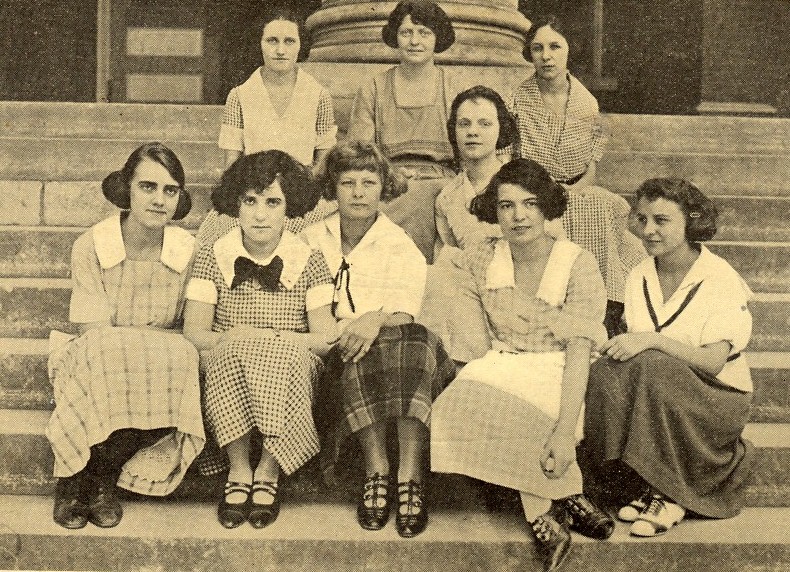
SENIOR DOMESTIC ART GROUP
| Margaret Ballard |
Sarah Blitch |
| Carrie Belle Dickinson |
Mary Gignilliat |
| Alice Kenner |
Wallie Konetzko |
| Daisy Lazarus |
Eloise Leybourne |
|
|
pgs. 21 to 29
Eight Domestic Art Girls sitting in a row,
All learning to sew, sew, sew.
Mary, Sarah, and Eloise,
Each working on her clothes, busy as bees.
Margaret using her left hand and perched on a stool,
Causes much fun in Domestic Art School.
Wallie and Carrie Belle, inseparable friends,
Make charming garments at little expense.
Daisy, the brunette, the odd one it seems,
Designs the daintiest clothes fit for queens.
Alice, the eight of this fair group,
Spends her time hunting patterns that suit.
So endeth the tale I have told to you,
About the Domestic Art Class of '22.--ALICE
KENNER |
§
The Domestic Science Class 1922
Is composed of very few
But these few stand
For everything grand.First there is our teacher
Who's the daughter of a preacher;
The pupils in roll are eight,
Working for their fate.
Sarah is always slow,
But her sewing makes a show,
Then Margaret, who, with her left hand,
Makes things neat and span.
Daisy spends her spare time with needle and thread,
Trying hard to keep ahead.
Eloise sits on a stool and sews,
Wondering when she will finish her clothes.
Mary, who spend her time whipping lace,
Has learned to work at a very fast pace.
Carrie Belle, with her sewing dainty and fine,
Is ready to sew all the time.
Wallie works patient and steady
But when fun is suggested she is ready.
Alice, not least of the fair class,
Does not let an idle moment pass.
After our English, History and other lessons are done
To the Domestic Arts Class we always run,
Here we spend the periods sewing,
Which is well worth knowing.
--MARY GIGNILLIAT |
§
|
DISILLUSIONMENT
It isn't just newspaper
talk that young men are afraid to marry these days, but still
thousands are marrying and taking happiness as a chance.
The far seeing middle class young man is afraid to take
upon himself the support of a modern maid, and in some respects the
newspapers and magazines are to blame. They tell him that a
modern girl can neither mend, sew, cook, nor perform any of the real
housewifery arts.
Here Robert, or Alfred, or Lewis puckers up his brow in
thought. He thinks of Mary and Elizabeth as sweet and
alluring, but how about keeping house with her?
This leads up to the story of Jane Griffin, one of
those new-fashioned maids who took matters into her own hands.
Jane's name just suited her, brown haired, grey eyed, a
beautiful complexion, and she was a jolly, clever, good tempered
girl. She was a stenographer in a law office.
She thoroughly enjoyed her office work. Girl and
boy friends called often, and Jane was always out for a good time.
But best liked among her friends was Albert Eason.
He often called at the Griffin home and perhaps ate an
occasional meal there. And as her friends expressed it
"he took Jane to everything" but here matters ended.
He seemed very fond of Jane and he should have known
that she preferred him to her other friends--but he, too, had an
idea that modern girls were worthless home-makers, and was afraid of
marriage.
One evening after a show, Jane and Albert were talking
about the beauty and marvelous art of the actress.
"She," said Albert, "is one who has an excuse to avoid
domesticity. She is an artist, her career is her excuse."
"I do not agree with you there," said Jane.
"But, you and I know dozens of young married women who
seem to scorn honest, actual home-making," answered Albert.
"The very idea," cried Jane, "I don't know where you
got such an idea. Most girls look forward to marriage and a
home and I think they do pretty well on the job, too."
"Oh, yes," answered Albert sneeringly, "they open up
some canned goods, buy a dish of salad and a loaf of bread and
that is what they call dinner.
"Just for that Albert Eason I am going to give you a
much needed object lesson," said Jane. "And I am one of those
common-place girls you were speaking about."
"I did not say common-place, and I certainly did not
mean anything personal," interrupted Albert.
"Now listen, next Sunday will be mother's birthday.
That means a big dinner in the afternoon. I suppose you will
agree with me that a dinner for nine would be harder to prepare,
than one for the underfed husband you were talking about."
"You come to the house early Sunday morning, and watch
me prepare the dinner all alone. Besides the five of us at
home, brother Donald and his wife, Aunt Mary and your honorable self
will be present."
"Do you feel sure you can do it alone?" asked
Albert as he pictured the office girl in the kitchen.
"I am sure of success," said she.
So it was arranged.
Albert arrived on Sunday morning a little after eight
and found Jane waiting for him.
They went to the kitchen and she gave him a chair so he
could see everything that went on.
First she washed and dried the breakfast dishes,
refusing his assistance. She then began preparing her dinner
which was to consist of tomato aspic, roast leg of lamb, June peas,
hot rolls, potatoes, hearts of lettuce salad, and Charlotte Rousse.
Her mother came to the kitchen several times to see if Jane needed
her help, but each time she was confronted with, "Now mother, go
right back, I am to do this all alone."
Finally dinner was served and it proved a success in
every respect. But all the time Albert was worried, he was
afraid Jane had only done this to show him what he had missed.
What if she should refuse him now?
Late in the afternoon Albert asked Jane to go to ride.
She consented, so they rode forth in his roadster. At first
they went at a rapid rate, but when they neared the country Albert
slowed down. As he turned toward the silent Jane he was she
looked rather pale.
"Little girl, I must apologize, you showed me that it
was foolish to think an office girl was not capable of doing house
work. Jane, will you marry me?" he continued.
"No, I will not," snapped Jane. "Today you sat and
watched me work my head off nearly before you. And now, being
convinced that I would make a capable and practical wife you wish to
marry me."
"But Jane, I really love you, although I do not deserve
you after I have been so slow."
After much talk that I fell sure would not interest
us--Jane smiled and told Albert she would think it over.
"But Jane where on earth did you learn to cook so
well?" asked Albert.
"Oh," said Jane, smiling happily, "I took a course in
Domestic Art during my high school education."
"And," thought Jane, "I am proud of my high school
training which has enabled me to give a much needed lesson to the
man I love."
--WALLIE KONETZKO |
§
|
Class Poems
TO A STUDENT
When you've lost all your pep and are losing your
rep,
And failure looks long in your eye;
And you're scared at exam, since you didn't cram,
It's natural that you should not try.
But the code of our school says "Don't be a Fool"--
It's no use to grouch or get mad;"
At exemptions from tests--oh, it's easy to jest,
It's the "barred-from-promotion" that's bad.
"You can't get your work!: That's no reason to shirk,
You're young, and you'd better start right;
"You've had a hard time"! I know, but don't mind,
Just show all that's in you and fight.
It's the study each day, that will win you the way,
Don't give up the struggle, old pard;
It's easy to quite and to failure submit,
It's the "keeping-your-work-up" that's hard.
It's easy to say that you'll get thru some day,
It's easy to shirk and to crawl;
But to work and to try when you may not get by,
And to rise again after each fall,
Should be the rule of each person in school;
What harm if your record is marred?
Oh it's easy to quit, and to lose all your grit,
It's the "keeping-on-trying" that's hard.
--RAY WHITTLE, '22 |
§
|
A SENIOR SONG FOR GRADUATION
(1)
I've studied hard to make my units,--
O Teacher! Let me pass!
I meant it right, if I wrote it wrong,
My pen just worked so fast!
(2)
I should have spread my efforts
More evenly across the year;
But here I've waited--waited--
And Commencement time is here.
(3)
I've tried to answer the questions,
I hope my answers are clear.
Teacher, don't look so solemn and stern
You fill my young heart with fear.
(4)
I've studied hard for my sheepskin--
I did it all toward the last,
Teacher, don't look so solemn and stern,
Please teacher, let me pass!
--MARGARET BALLARD, '23 |
§
|
THE PSALM OF A STUDENT
(With apologies to Longfellow)
Tell me not mournful numbers
School is but a n empty dream,
That the student's lost, that slumbers
And lesson, not what they seem.
History's real, French is earnest
And Graduation is the goal,
Tho' your brains you overturnest
It may not be 'neath control.
No enjoyment and no pleasure
have we had throughout this year,
Not a single space of leisure
Not a thing in this small sphere.
Days are long but time is flying
And altho' I'm now serene
Soon I will be weeping, crying
O'er that long, long history theme.
From this school's broad field of learning,
From the bivouac of this strife
Someday soon, I will be earning
Good wheat-bread--the staff of life.
Lives like Webster's all remind me
I could make my life some good,
And departing, leave behind me
A reputation like--Robin Hood.
Let me then be up and trying,
With a heart for any mark,
Still pursuing and not crying,
If my mind's left in the dark.
--LOUISE PFEIFFER, '22 |
§
|
GLYNN ACADEMY
G is for the GLADNESS which fills our hearts.
L is for the LOVE we have for our school.
Y is for our YOUTH, bubbling over with fun.
N is for the NATURE whose beauty surrounds us.
N is for NEWCOMERS welcomed always.
A is for ATHLETICS, in which we excel.
C is for The CUMTUX, our latest venture.
A is for our AMBITION to ever move forward.
D is for our DREAMS we hope will come true.
E is for EARNESTNESS our tasks to pursue.
M is for MEMORY of pleasant days past.
Y is for our last YEAR in Glynn Academy.
--SARA BLITCH, '22 |
§
|
A MODERN PILGRIM'S PROGRESS
As I sat through the study
period I grew weary and slept, and as I slept, I dreamed. I
dreamed a dream and behold, I saw a child clothed i clean clothes
and shining face, yet appearing to be nervous and at the same time
troubled. His face was turned from his House and in his arms
were Books. I looked and perceived that he opened one book and
a look of trouble crossed his face upon seeing therein many things
strange and mysterious. For this was Student's first
appearance at the Institution of Learning, and Student was
bewildered, even as you and I.
In this plight therefore, he went Home, and could
refrain himself no longer, but broke out with a lamentable cry,
saying, "What shall I do?"
His mother, having great understanding, shewed much
sympathy unto him. But Relations being audience to said
lamentable out-burst, shewed forth extreme indifference, not having
understanding of the situation. Student was hastened to bed,
and sleep soon settled his brain, bringing sweet forgetfulness.
The following day Student started forth again with
advice and an apple. He was on the first lap of the great
journey to Wisdom, which he knew was before him; being able to tell
by the glimmer of the light of the seal of Diploma, which was as yet
distant being four years off. Student started up the road that
Wisdom lay. He found traveling rather rough in spots, but
found much help from Tolerance who is a great help to all beginning
Students.
The road roughened and it became darker; a misstep and
Student has fallen into the Sough of Despond. Tolerance being
already exhausted, turned away, and mercilessly left Student
struggling in the Slough of Despond unassisted. Then in my
dream I beheld that Help came along and lifted Student from
Despondency.
After which the journey was easier, and by much
endurance Student reached the top of the first hill; there being
four such hills between him and his goal. Student perceived
that in the valley between the hills were numerous obstacles, and as
he journeyed on the burden with which he was laden became more
weighty.
Mr. Worldliness crossed Student's path and inquired of
him, "Whither away?" On being given the desired information he
was amused and smiled knowingly of the youth's simplicity.
Straightway he said he would furnish the means of lightening the
load on Student's tired back. This offered assistance was in
substance a ready-made help, in later days known as a "jack", or a
"pony". Even then at the same time Conscience appeared in
invisible form, and lightly pricked Student with a fountain pen and
said forthwith, "Why?" Student being touched to his heart,
dismissed Mr. Worldliness with a few well-chosen, snappy words, and
with a determined look upon his face proceeded upon his way.
After some time of pleasant traveling, Student found
himself upon the banks of the River of Difficulty and with no
seeming means of any manner of transportation. Soon he heard
the splashing of oars and there came a boat with Diligence at the
helm, who put him safely on the other side of the River of
Difficulty. Student so marched on, and triumphed over many
obstacles.
When traveling was very heavy, and Student was weak,
worn, and weary, he turned a bend and there beheld Ignorance
standing at the entrance of the Castle of Doubt by which Student's
journey lay. Here he was enticed to enter, and was told in
glowing terms of the great city that lay beyond, where positions of
every kind were given to boys, and money was galore, and no
experience or education of a high degree was required. The
influence of this Castle of Doubt was overpowering, and Student was
about to yield to its enticing sound. But at the psychological
moment, there appeared two men. These two were Reason and
Fact, by their plain argument Student was convinced that he was
about to take the wrong course in life. He turned to battle
with Ignorance, but behold! He had disappeared to wait for
another weak Student, and to entice him in the same way and perhaps
win; because he must have victims for his master, Failure.
Student fully realized his narrow escape and set about
his work of advancing with a new vigor and determination to finish
his journey. After many other hard fights with various
difficulties, he finally arrived at the gate to the Castle of
Reward. Messengers ran out to greet him and bid him welcome.
He was carried before a vast throng and was there presented with a
scroll which was a coveted object. The man presenting it to
Student said, "Oh, young man, you have fought a good fight, and won
a difficult battle. But hearken unto these, my words: in
reaching this Reward you have not reached Wisdom and you have not
finished your course. This scroll will pass you to another
course of life; at the end of this you will be presented with
another scroll. With this you will have knowledge and will
enter the journey of Life."
--KENNETH BELL, '22 |
|

|
Pgs. 30 & 31

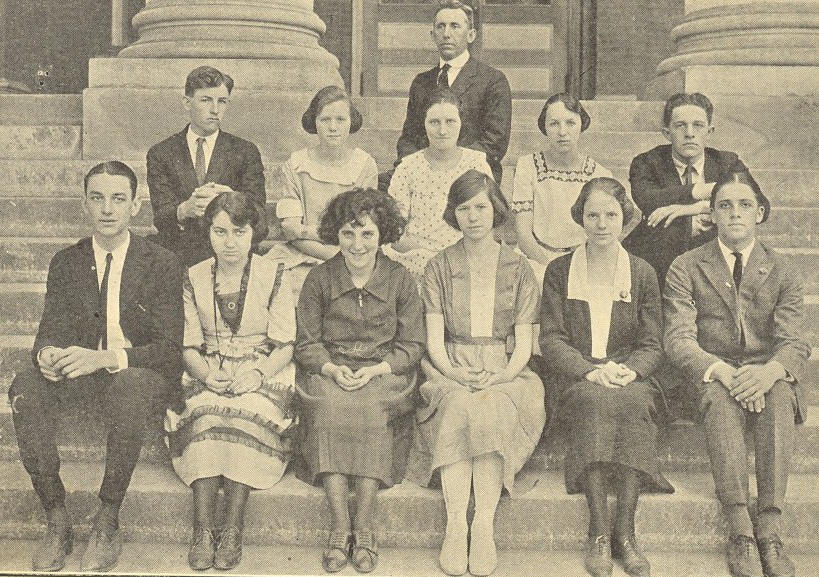
SENIOR COMMERCIAL GROUP
| Dolores Artau |
Wallie Konetzko |
| Henry Beach |
Daisy Lazarus |
| Carrie Belle Dickinson |
Joanna Newman |
| Margaret Flanders |
Bernard Owens |
| Elizabeth Harris |
Judson Smith |
|
|
pgs. 31 to 37
|
A Professor of Philosophy
once crossed a lake in a row boat. As he journeyed, he
conversed with the boatman, asking him various questions as to his
attainments. "Have you studied Philosophy?" asked the
Professor.
"No," answered the boatman. "Then, my man, you
have lost half of your life. Have you studied literature?"
"No." "Then, my dear man, you have certainly lost half of your
life. Have you ever studied Science?" "No." "My
dear, dear man, I am very sorry for you. You have lost a large
part of your life." At this moment a squall broke upon the
lake, and the boatman, turning to the Philosopher, inquired with a
grin, "Have you ever studied swimming?" "No," answered the
Philosopher. "Then, my dear sir, you have lost all of your
life," and as the boat sank, he jumped overboard and swam to the
shore.
Like the Professor, each of our instructors secretly
believes his department to be the only one, or at least, by far the
most important. We are fully aware of the importance of
knowing the use of a comma, and whether a sentence is compound or
complex and we know that it is not always simple to tell which.
History is also essential to the making of a true American.
Not to know the significance of 1492, 1607, 1776, 1789, 1803 and
other less important dates would certainly be a crime. And we
must be specific in telling the significance. The Scientist
thinks none of us are educated unless we can describe minutely the
nervous system of a caterpillar or know that CO2 means carbon
dioxide.
In this day of international intercourse, the foreign
language department is becoming quite popular and each period there
can be seen many heads bent low, laboring over some long
translation. Even the remains of Latin, which has been dead
for many years, still has a place in the school curriculum, and like
all the others is considered by the instructor as the most
important. The head of the Domestic Science Department has
even persuaded her girls to believe that their department takes the
lead, and she is not far wrong, for what would a poor girl do with a
hungry man if she was not versed in the science of cooking?
But after all, what in this world can be accomplished
unless done in a business-like manner? We will be pardoned, I
am sure, if we take our place with the rest and realize as they that
our work is the most important. We believe it to be the
foundation of all other departments. At every period the
typewriters can be heard clicking away at the rate of forty words a
minute and the Bookkeeping room across the hall is full of equally
industrious pupils. The Bookkeeping course requires two years
while Stenography is generally mastered in a year and a half.
The fact that eleven out of twenty-six Seniors have chosen to take
the Commercial Course, or at least the Stenographic part of it, is
proof of the popularity of this department. It is well to be
prepared for everything, and there will necessarily be some girls
and practically all boys who will have to provide materials for
existence, and we would hate to be caught as the professor with whom
this story opened.
Many in the eleventh grade have taken Stenography
through the Summer and finished their course in a much shorter time.
To be able to get our units in Stenography we have to be able to
take dictation at the rate of forty words a minute and then write
this on the typewriter with very few mistakes. The
typewriting requirement is forty words a minute.
--ELIZABETH HARRIS, '22 |
§
CLASS ACROSTIC
| Dolores Elizabeth Artau |
Does Ever Advance |
| Sarah MacDonald Blitch |
Serves Marvelous Breakfasts |
| Tillie Reiman Borchardt |
Took 'Round Baxley |
| Charlotte Belle Carruthers |
Class' Best Consultant |
| Carrie Belle Dickinson |
Can't Be Daunted |
| Margaret Louise Flanders |
Makes Lovable Friend |
| Mary Gignilliat |
Mighty Good |
| Elizabeth Hammond Harris |
Enjoys Her History |
| Alice McEven Kenner |
Adds Much Kindness |
| Wallie Ann Konetzko |
Wonderful (in) a Kitchen |
| Sarah Cornelia Leavy |
She Capers Lightly |
| Daisy Grace Lazarus |
Doing Good Lately |
| Susie Eloise Leybourne |
She Enjoys Laughing |
| Helen Marks Lissner |
Has Many Laurels |
| Jewell Mitchell |
Joyfully Memorizes |
| Joanna Heleanor Newman |
Just Hates Narrowness |
| Mary Edward Parker |
Makes Eyes Perfectly |
| Louise Marks Pfeiffer |
Learns Most Perfectly |
| Henry Fair Beach |
He's Fast Ballplayer |
| Edward Cecil Bruce |
Easily Conquers Banners |
| Floyd Kenneth Bell |
Fair Knight--Bassanio |
| Bernard Owens |
Big Optimist |
| Jacob Maximillan Wengrow |
Jokes Most Willingly |
| Ray Walker Whittle |
Ranks With Winners |
| Albert Merion Smith |
Always Making Smiles |
| Judson Butts Smith |
Jolly, But Sincere |
--DOLORES ARTAU, '22
§
|
"1922"
"S-elf-reverence, self-knowledge, self-control,
these three alone lead life to
sovereign power."
"E-conomy is the poor man's mint."
"N-oble souls, thru dust and heat,
Rise from disaster and defeat
The stronger."
"I-ndex-learning turns no student pale
Yet holds the eel of science by the tail."
"O-bedience is the Christian's crown."
"R-eason raise o'er instinct as you can
In this 'tis God directs, in that 'tis man."
"C-onscience is harder than our enemies,
Knows more, accuses with more nicety."
"L-ovely indeed the mimic works of art,
But Nature's works far lovelier."
"A-ll things are ready if our minds be so."
"S-elf love is not so vile a sin
As self-neglecting."
"S-elf defense is a virtue
Sole bulwark of all right." --DAISY
LAZARUS, '22 |
§
|
AN EVENING SPENT IN NIGHTMARE ABBEY
Ten o'clock, and after
bidding goodnight to the several friends who had called on me, I
thought of my neglected lessons for the first time. And oh,
the lessons I did have to get! I had made all kinds of
resolutions to study when I brought my load of books home that
afternoon, but following my motto of "pleasure before
business," I had waited till now to get them.
With many a sigh of regret I searched for the books I
had carelessly thrown aside, finding them at last scattered over the
floor, where my little sister had been searching for pencils, papers
and drawings she considered her own. At last I was settled
down for work. A story to write in English, study for history
test, and a biology test, several pages of Spanish to translate, and
a new lesson in shorthand was my program for the next day. Oh,
what a life!
I tried to think up a story, but my plots were so
jumbled they would have made a crazy quilt appear tame in
comparison. Abandoning this at last, I tried to study the
cause and effects of the Revolutionary--or was it the Civil War?
While I was trying to study, I was also having a lot of
difficulty keeping my eyes open, and my head felt too heavy for my
neck and shoulders. At last, in a final attempt to keep awake,
I began to study a picture of an old English monastery which hung on
the wall. The monastery seemed to grow in size; and in
reality, the longer i looked at it. I began to imagine all
kinds of strange things concerning it.
I was lost in a great forest, and suddenly I stood
before an old abbey, covered with vines and leaves. It was
gruesome looking and forbidding, but I was curious to know what was
inside so I went in; not without misgivings as to the consequences
of this adventure. Passing through a dusty, gloomy hall, lined
with yellow, worm-eaten books, I was startled by a sound of clashing
swords in a room nearby. Who would have thought there was
anything alive in this dead looking place! I was at first
terrified, and then curious to know what was happening inside.
Opening the door, which squeaked, and peering inside, I saw two men,
fighting awhile with their swords and then resting awhile.
One, a short, stout man in an ill-matched coat of armor, I took to
be a Spaniard by his appearance and dress. The other man was
tall and stately, dressed in a Roman toga, I knew he was a
Roman by his nose. At last they saw me standing there watching
them and stopped fighting long enough to ask me who I was, what I
was doing there, and what I wanted. Suddenly I recognized the
tow and exclaimed to the Spaniard, "Why senor, you are Don Quixote
de las Mancha, whom I have been having so much trouble with in
Spanish class. And you sir," turning to the Roman, "are
Caesar, my enemy in Latin class." They stared at me in
amazement, and suddenly both began to demand at once, "Who wrought
the greatest deeds, Caesar or I?" And, "what do you mean by
confusing me with that Don Quixote, and translating me
incorrectly every day?" They looked and acted as if they would
have liked to use their swords on me; and fearing they would turn
thoughts into action, I ran from the room and slammed the door after
me.
I was again in the hall, and passing along I saw on a
door a huge sign which said "keep out."
"No trespassing" signs ever bothered me, and opening
the door I was almost deafened by the roaring which greeted me.
Lincoln and Douglas were debating on one side of the room, and
Webster and Hayne were debating on the other side. Washington,
Jefferson, Hamilton, Adams, Franklin, Lee and many others were the
audience. Now these tow debates had given me much trouble in
American history, and I thought I now had a chance to straighten
them out in my mind. I listened, or tried to, for several
minutes but became even more confused than before, for both debates
were going on at once.
Washington and Hamilton had gotten into a dispute over
something, and the others were trying to keep them from fighting.
The whole atmosphere of this room was one of conflict, and as I am a
pacifist I decided to get out before war began in earnest. No
one had paid the slightest attention to me in this room anyway,
didn't even know I was there, and my self-esteem was injured by this
neglect.
I determined that I would be noticed in the next
room I entered, so for the first time I decided to knock before
entering. I did, and the door was silently opened. "At
least," I thought to myself, "there is no noise or conflict going on
here." I walked in, almost knocking over a skeleton standing
by the door. I was horrified at the sight which met my eyes.
Gazing around the room, I saw other skeletons standing around, with
worms, bugs, snakes, and everything nasty and creeping, crawling all
over them, the floor and the walls. I turned to run out of the
room, but there was that ghostly skeleton standing guard in front of
the door. Suddenly, its lower jaw began to move and a hollow
and metallic voice asked, "What do you want? Are you a
scientific research worker?" I could not speak at first but
finally I managed to stammer, "N-no, s-sir, I-I am not, sir, b-but
p-please sir, I w-would l-like to get out of here." I again
heard the voice saying, "You wanted to come in here and now you
can't get out unless I see fit. Perhaps we will dissect you
and see how much your brain weighs, and see if you have been
troubled by any kinds of disease. I am Prof. Young and these
other gentlemen you see standing around the wall are my
fellow-scholars. We have given our whole lives to science, and
our bodies after death. These reptiles and insects are our
specimens. Perhaps you would like to join our great work of
physiological and zoological knowledge?"
With this, he and the other skeletons, accompanied by
the frogs, reptiles, and insects, started towards me, and with a
terrified shriek I started for the door, upsetting one of the
skeletons. The skeleton and I struck the floor with such force
that our bones rattled, and I was almost senseless. We made a
terrible racket alright.
At first I was too frightened to open my eyes, but when
I did I was both astonished and relieved. The mysterious abbey
and its inmates had completely disappeared, and I was lying on the
floor with my books scattered all about me. The chair in which
I had been sitting was overturned as was also the table on which my
books had been. I was much bewildered, and very glad indeed
when I saw mamma and my sister come running in. Daddy followed
the procession, and I knew something unusual must have happened to
excite him so much. They had been alarmed by the
terrible noises the furniture and I had been making and had come to
investigate, thinking nothing less than the roof had fallen on me.
It was a great relief to me, indeed, to find that all
of my experiences had been only imaginary ones, but I never,
never want to spend another night in Nightmare Abbey.
--JOANNA NEWMAN, '22 |
§
| LOUISE P |
F |
EIFFER |
| CORNELI |
A |
LEAVY |
| MARY PA |
R |
KER |
| CHARLOTT |
E |
CARRUTHERS |
| BERNARD O |
W |
ENS |
| HENRY B |
E |
ACH |
| JEWE |
L |
MITCHELL |
| HELEN |
L |
ISSNER |
| |
|
|
| KENNE |
T |
H BELL |
| JUDS |
O |
N SMITH |
| |
|
|
| CARRIE BELL |
D |
ICKENSON |
| DOLOR |
E |
S ARTAU |
| MARGARET FL |
A |
NDERS |
| TILLIE BO |
R |
CHARDT |
| |
|
|
| WALLIE K |
O |
NETZKO |
| DAISY |
L |
AZARUS |
| E |
D |
BRUCE |
| |
|
|
| MARY |
G |
IGNNILAT |
| SARAH B |
L |
ITCH |
| ELOISE LE |
Y |
BOURNE |
| ALICE KE |
N |
NER |
| JOANNA |
N |
EWMAN |
| |
|
|
| ELIZABETH |
H |
ARRIS |
| ALBERT SM |
I |
TH |
| JACOB WEN |
G |
ROW |
| RAY W |
H |
ITTLE |
|
|
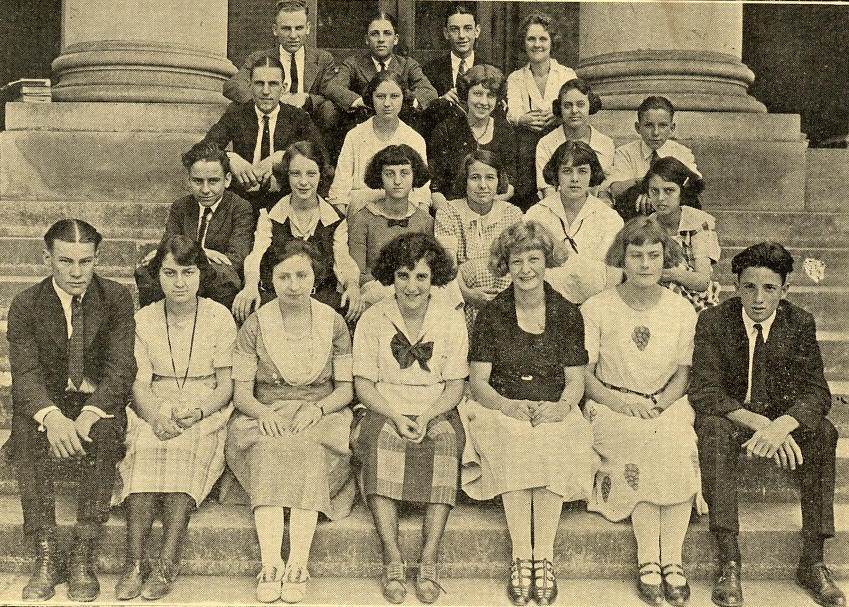
pgs. 38 & 39

Click photo to enlarge!
GLEE CLUB
A Glee Club was organized this year
under the supervision of Miss Goodwin. With regular weekly
practice it has accomplished many things which does it credit.
The entire club gave various selections during
Educational Week and since that time it has appeared before the
upper assembly.
The girls' chorus sang for the Woman's Club in costume
appropriate to their selections. They have likewise given
numbers for the assembly.
Since such good work can be done with the material of
Glynn Academy, and so much pleasure as well as benefit is derived
from the practices, we hope that next year there will be a club to
succeed the present one.Accompanist--Helen Lissner,
'22
Members--Daisy Lazarus, '22; Daisy Emanuel,
'24; Mary Parker, '22; Anne Smith, '23; Mary Wilson,
'23; Eleanor Missildine, '23; Dolores Artau, '22;
Eloise Miller, '23; George Gowen, '23; Henry Beach,
'22; Ralph Smith, '23; Eugene Gignilliat, '23;
Richard Peters, '23; Doles Wilchar, '24; Eloise
Leybourne, '22; Naomi Prim, '24; Louise Pfeiffer,
'22; Judson Smith, '22; Cornelia Leavy, '22. |
|
|
pgs. 40 & 41

Click photo to enlarge!
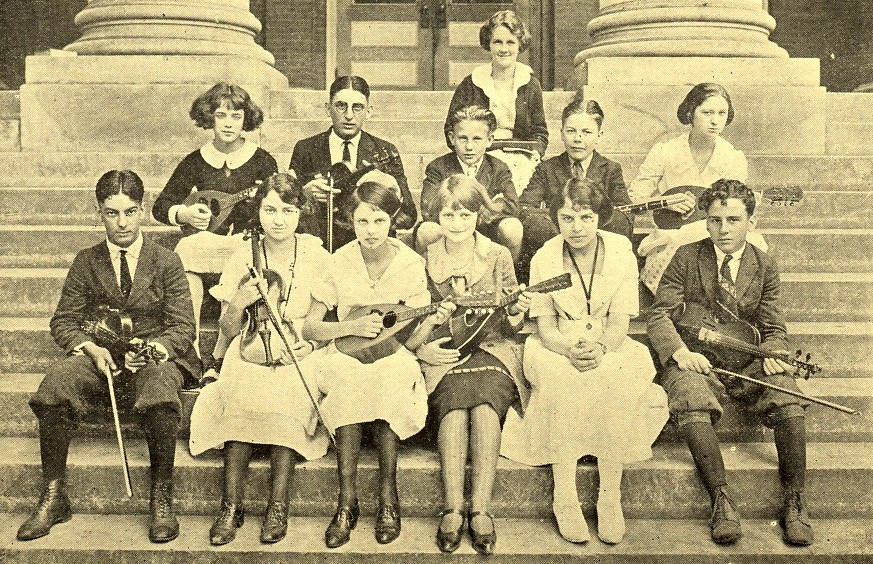
THE HIGH SCHOOL ORCHESTRA
The best intentions
sometimes fail. And though our orchestra has not reached this
calamity, we have not fully accomplished what we had first planned.
Let it be remembered that we were laboring under difficulties.
There was always a lack of music and at best we are only amateurs in
the world of music. With this in view we were launched on our
career in September, 1921. With Miss Goodwin as our capable
and untiring pilot, we have steered safely to port.
Our initial appearance was in the pageant given just
before Thanksgiving. We gave one morning performance in the
assembly. Our last appearance was at the "Chinese Lantern," a
play rendered by the high school students for which we furnished
Chinese music before the play and between acts.
The orchestra is still in its infancy. There is
an abundance of good talent to carry on this work, and it is my
earnest wish that the work of this organization which is so
necessary to the social activities of Glynn Academy be carried on to
success.MEMBERS:
Accompanist--Tillie Borchardt, '22
Violins--Dolores Artau, '22; Benito Artau, '24;
William Ford, '25; Maurice Zelmenovitz, '24.
Clarinet--Smedley Missildine, '25.
Cornet--Merril Langford, '25.
Mandolin--Cornelia Leavy, '22; Louise Pfeiffer,
'22; Lillian Gordon, '24; Naomi Prim, '24. |
|
Back to No. 3 Index
Back to Cumtux Intro
|